

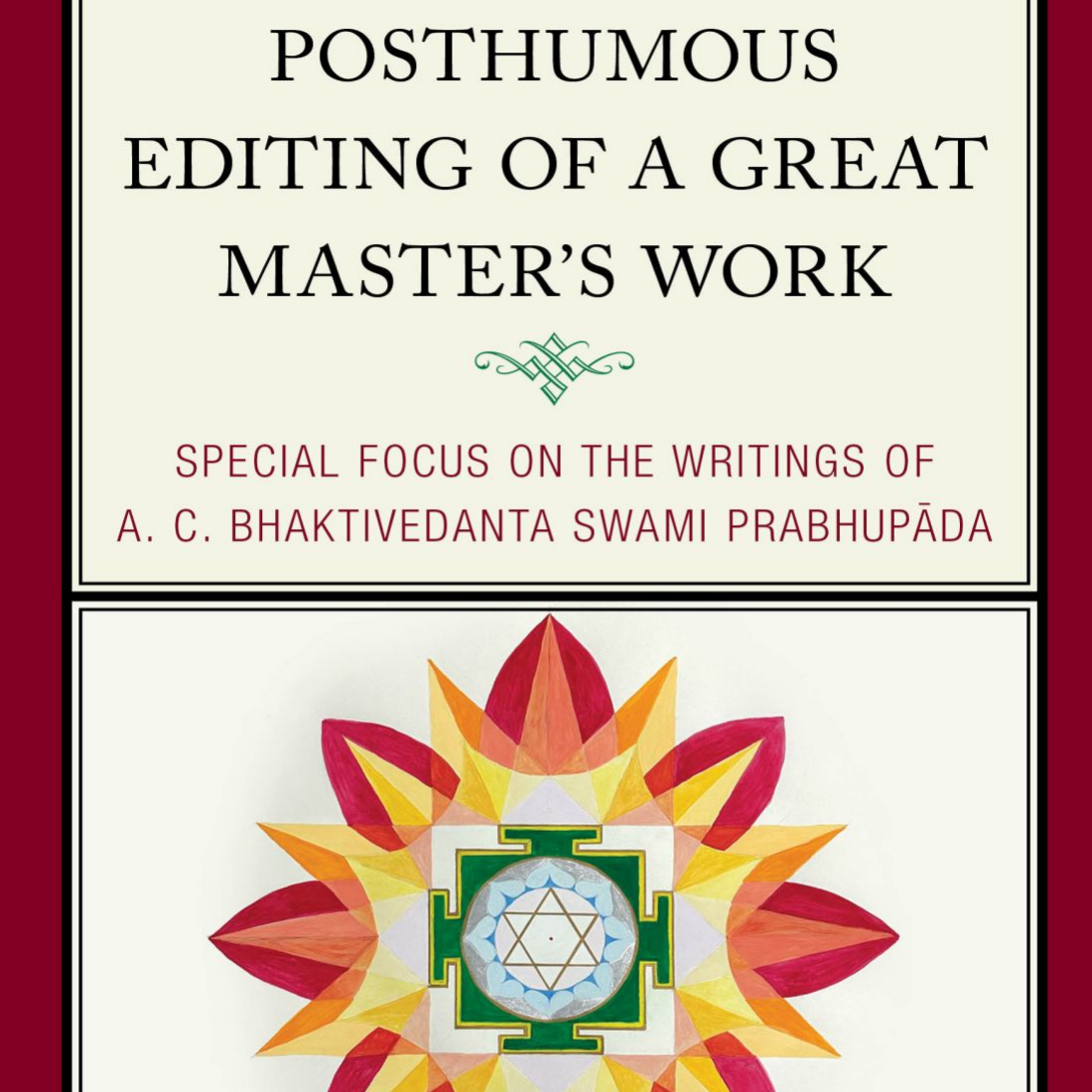

How an academic solution reproduces the problem it diagnoses.
I read this book twice. Once out of genuine interest — the editing of Prabhupāda’s books has been an open wound in ISKCON for decades, and here, finally, was a Lexington Books volume with twelve scholars and actual academic weight behind the argument. The second time I read it slower, with a growing unease I could not immediately name.
In February 2020, fourteen academics had gathered at the Graduate Theological Union in Berkeley, California. The Flora Lamson Hewlett Library. Good coffee, leather chairs. The conference was organized by Graham M. Schweig — Professor of Philosophy and Religious Studies, doctorate from Harvard, author of his own Bhagavad-gītā translation, editor of Tamal Krishna Goswami’s posthumous thesis. Also an initiated disciple of the man whose books were under discussion, though you would not guess it from the way he talks about him.
Four years later, the proceedings appeared as Posthumous Editing of a Great Master’s Work. Two hundred and forty pages. Index, bibliography, the full academic apparatus. The book documents how the Bhaktivedanta Book Trust took nearly five thousand liberties with Prabhupāda’s Bhagavad-gītā As It Is after his departure in 1977, altering seventy-seven percent of its verses without the author’s knowledge or consent.
The documentation is devastating. The critique is largely correct.
The unease I mentioned came from what happens after the diagnosis. The solution Schweig proposes reproduces the exact structure of the problem he spent seven years taking apart.
The Correct Diagnosis
I want to be fair to the book before I take it apart. Schweig identifies the BBT’s editorial crisis with real precision. He names four failures:
A false assumption of authority — where Prabhupāda granted only limited, supervised editorial permission during his lifetime, the BBT editors extrapolated an unlimited posthumous mandate. An editorial overreach — where the author requested correction of grammar and spelling only, the editors rewrote purports, altered translations, and imposed their own stylistic preferences. A noncompliance with scholarly standards — where any competent textual scholar would have maintained transparency and preserved the author’s final published text as authoritative. And editorial changes without transparency — where devotional and academic standards demanded full disclosure, the BBT published its heavily revised edition as though it were simply Prabhupāda’s book, improved.
Each of these charges is documented. Each holds up.
The book also surfaces the principle of ārṣa-prayoga — the Vedic convention that the words of a sage, even when grammatically unconventional, carry spiritual authority and should not be “corrected” by lesser hands. Prabhupāda himself invoked this principle:
“Arsa-prayoga means there may be discrepancies but it is all right.”
Six words. That should have been the end of it.
Schweig heard them. He cited them. And then he kept going.
The Hemingway Problem
The book’s opening move tells you everything. Schweig begins not with Prabhupāda, not with the Bhāgavatam, not with any text from the tradition whose master’s words are at stake. He begins with Hemingway. He cites an article from the Modern Language Association. He quotes a literary journalist who calls posthumous editing “literary necromancy.”
The frame is Western literary criticism. The tools are textual scholarship, publishing ethics, copyright law. The analogies are secular. The Śrīmad-Bhāgavatam shares analytical space with The Garden of Eden.
This is not a minor stylistic choice. It is a category decision that determines everything that follows.
Prabhupāda’s books are not novels. They are bhāṣyas — authorized commentaries within a disciplic succession tracing back to Kṛṣṇa through Brahmā, Nārada, Vyāsa, Madhva, and Caitanya Mahāprabhu. The Bhagavad-gītā As It Is is not “a work” in the sense that A Farewell to Arms is a work. It is a transmission of śabda-brahma — transcendental sound descending through a chain of realized souls. The authority of its purports does not rest on Prabhupāda’s prose style. It rests on his spiritual realization, his fidelity to his own guru, and the power of the paramparā flowing through him.
When you treat such a text with the instruments of secular criticism, you have already conceded the argument to the BBT editors. They, too, treated it as a manuscript to be improved. The disagreement becomes merely about degree — how much improvement is acceptable — rather than about kind. The Hemingway frame makes the question “How should we edit this book?” The paramparā frame makes the question “Should we be touching this at all?”
Schweig chose Hemingway. I kept waiting for the chapter where he would step out of that frame and into the one Prabhupāda actually operated in. It never came.
The Disciple Who Isn’t
In various statements leading up to and surrounding the project, Schweig has described himself as “not an ISKCONite” and has distanced himself from the identity of a Prabhupāda follower.
He is, however, an initiated disciple.
This is not a minor biographical detail. In the Gauḍīya tradition, initiation — dīkṣā — is the most consequential commitment a soul can make in a human lifetime. It establishes an eternal relationship with the guru. It carries obligations that do not expire when the disciple earns a doctorate. The Śrīmad-Bhāgavatam is unambiguous:
“Yasya deve parā bhaktir yathā deve tathā gurau” — one’s faith in God and one’s faith in the guru must be equal and absolute. (ŚU 6.23)
Schweig does not refuse his guru. He does something more complex. He places the guru inside a frame — the academic frame — where the guru becomes a subject of study rather than a source of authority. Prabhupāda’s instructions become “data.” His books become “texts.” His desires for those texts become “evidence” to be weighed against competing considerations.
An initiated disciple treating his guru’s direct instruction — “do not change my books” — as one factor among many in an editorial calculus. Not disobedience. Something subtler. The guru’s words are acknowledged, cited, footnoted, and then overridden by a methodology the guru never endorsed.
The Anniversary Edition
The final chapter of the book is Schweig’s own. He titles it “Framing the Master’s Work: On the Theo-Literary Method for Preserving the Completed Writings of the Departed Spiritual Preceptor.” In it, he announces his own solution: an “anniversary edition” of the Bhagavad-gītā As It Is, in which he will apply the conclusions of the volume.
He describes his approach as keeping Prabhupāda’s original text untouched while adding scholarly annotations — forty-five endnotes providing “source identification” and “scholarly context.” He compares this to adding “an elegant frame” around a painting without retouching the painting itself.
The metaphor is revealing in ways Schweig may not intend. A frame is not neutral. A frame tells you how to look at what’s inside it. A frame says: this requires framing. This is not sufficient on its own. It needs context — my context — to be properly understood.
Prabhupāda said his books should remain “as they are.” Not “as they are, plus forty-five endnotes.” Not “as they are, inside an elegant frame.” Not “as they are, with source identification provided by a Harvard-trained scholar.” As they are.
The phrase either prohibits all intervention or it permits selective intervention. It cannot logically do both. Schweig needs it to do both — to prohibit the BBT’s intervention while permitting his own. The distinction he draws is between “changing the text” and “supplementing the text.” But this is a distinction the instruction does not make. “As they are” does not mean “as they are, plus supplements.”
The BBT used scissors. Schweig uses a frame. The underlying conviction is identical: what Prabhupāda left is not sufficient as it stands.
And footnotes are not as harmless as Schweig makes them sound. They shift the reader’s attention from the author’s words to the annotator’s commentary. Over time, that commentary becomes the lens through which the text is read. A footnote implies insufficiency — it says the original author did not fully convey his meaning and needs someone else to clarify him. Once institutionally distributed, those annotations stop being optional. They become canonical, welded to the original text. And they set a precedent: if Schweig can annotate Prabhupāda, who is next?
Prabhupāda used footnotes in his Delhi editions in the past. But they were his footnotes. The issue is not the format. It is who holds the pen.
The Marketplace of Gītās
There is a fact that the book does not discuss, and its absence is loud.
Schweig is the author of Bhagavad Gita: The Beloved Lord’s Secret Love Song (HarperOne, 2010). He is the author of Dance of Divine Love: India’s Classic Sacred Love Story — The Rasa Lila of Krishna (Princeton University Press, 2005). He is, in other words, a scholar with his own competing translations of the very texts whose editorial integrity he is defending.
I am not saying Schweig sat down and thought, “How can I use this controversy to sell my own Gītā?” I do not think that is what happened. But sincerity does not eliminate structural conflict, and the conflict is glaring. The man proposing the definitive editorial methodology for Prabhupāda’s Gītā is the same man who publishes his own Gītā. In any other field — medicine, law, journalism — this would be disclosed in the first paragraph. The book never mentions it.
And then there is the panel. Schweig’s institutional recommendation: an Editorial Review Panel, a body of “scholar-practitioners” with expertise in Sanskrit, textual criticism, and Vaiṣṇava theology, empowered to evaluate all editorial changes to Prabhupāda’s books.
I kept looking for the page where Schweig explains who gave this panel jurisdiction. I did not find it. Not Prabhupāda — he left an instruction, not an institutional mechanism. Not the paramparā — the disciplic chain does not operate through academic committees. The authorization comes from the academy itself, which is to say, it is self-appointed.
Prabhupāda did not require a panel. He required śraddhā — faith. He required sādhu-saṅga — the company of devotees. He required bhajana-kriyā — the daily practice of chanting and hearing. He said, repeatedly, that his books could be understood through devotional service, not through editorial review.
The “scholar-practitioner” is a category that sounds inclusive and is actually exclusive. It filters out the very people Prabhupāda wrote for — the ordinary person, the struggling devotee, the person with no Sanskrit and no university — and replaces them with credentialed gatekeepers. A grandmother in Vrindavan chanting on her beads at four in the morning understands the Gītā in ways that a panel of comparative religion professors does not. Not because she is smarter. Because she has the one qualification the tradition recognizes: surrender.
“Naiṣāṁ matis tāvad urukramāṅghriṁ spṛśaty anarthāpagamo yad-arthaḥ” — the intelligence does not turn toward the lotus feet of the Lord so long as one has not tasted the dust of the feet of great devotees. (ŚB 7.5.32)
The verse does not mention doctoral committees. It mentions dust.
Schweig’s panel is Brahminical elitism wearing a peer-review badge.
The Gravity Paradox
Here is where the whole thing collapses under its own weight.
If Prabhupāda is an ordinary author — a man who wrote books that can be evaluated, corrected, annotated, and improved by qualified specialists — then the book is a competent editorial study and nothing more. Hemingway. MLA standards. A university press. Academic interest, limited audience, no particular urgency.
But the book is not marketed to the MLA. It is marketed to devotees. It is funded by devotees. It is dedicated to Śravanānanda Dāsa, “a loyal disciple of Prabhupāda for fifty years.” It draws its moral energy — its urgency — from the conviction that something sacred has been violated. That conviction only makes sense if Prabhupāda is not Hemingway. If his books carry spiritual authority that no editor has the right to alter.
Schweig borrows the gravity of the ācārya to give his academic project weight, then applies the methodology of the academy to adjudicate the ācārya’s words. He needs Prabhupāda to be sacred enough to generate outrage but secular enough to be annotated.
In the Gauḍīya tradition, there is a term for using the guru’s legacy while declining the guru’s authority. It is guru-droha — not the dramatic betrayal of open rejection, but the quieter betrayal of appropriation. Taking what serves you. Leaving what binds you. The BBT editors, at least, claim to act under Prabhupāda’s authority — wrongly, but the claim is there. Schweig claims authority over Prabhupāda’s work while explicitly distancing himself from the identity of a follower.
A disciple who disclaims discipleship. A critic who replicates the criticism. An editor who denounces editing.
I kept coming back to chess. In chess, a gambit is when you sacrifice a piece to gain a positional advantage. Schweig sacrifices his identity as a disciple to gain the positional advantage of academic neutrality. He gives up one form of authority — the spiritual — to claim another — the scholarly. The board looks different. The logic is the same.
The One-Sentence Answer
Two hundred and forty pages. Twelve scholars. A conference at Berkeley. Lexington Books. Endnotes, bibliography, index.
I finished the book at 2 AM and sat there thinking about those six words.
“There may be discrepancies but it is all right.”
Prabhupāda did not need a panel. He did not need an anniversary edition. He did not need forty-five endnotes or a Sarasvatī Yantra on the cover — a tantric-impersonal symbol gracing a book about a tradition whose entire point is that the personal is supreme. He needed his disciples to do something that requires no doctorate and no conference: leave his books alone and distribute them.
The editions he approved in his lifetime are the definitive editions. They contain the vāṇī — the words — of the ācārya, exactly as he chose to transmit them. Imperfect, perhaps, by the standards of the Modern Language Association. Perfect by the standards of the tradition that considers the ācārya’s words to be non-different from transcendental sound.
The books do not need correction. They do not need annotation. They do not need a frame. They do not need Graham Schweig.
They need someone willing to read them on their own terms. That is all they have ever needed.
Shastra first. Parampara always.