
Maria found the temple at thirty-four. A coworker had mentioned the philosophy during a difficult time: divorce, custody battle, the whole mess. Something about it made sense. The idea that suffering had meaning. That she could find peace even in chaos.
She started coming on Sunday afternoons, straight from her nursing shift. Still in scrubs sometimes. She’d sit in the back, listening to the lecture, trying to follow along.
The philosophy clicked. She bought books. She started chanting in her car during her commute. She asked questions after class. Good questions, the kind that showed she was actually reading.
But something was off.
People were friendly. Polite smiles, brief hellos. No one was rude. But after four months, she noticed she was still having the same surface conversations. Still sitting alone at the feast. Still invisible when people made plans.
One day she overheard two women talking near the kitchen.
“She seems sincere, but…” One of them gestured vaguely.
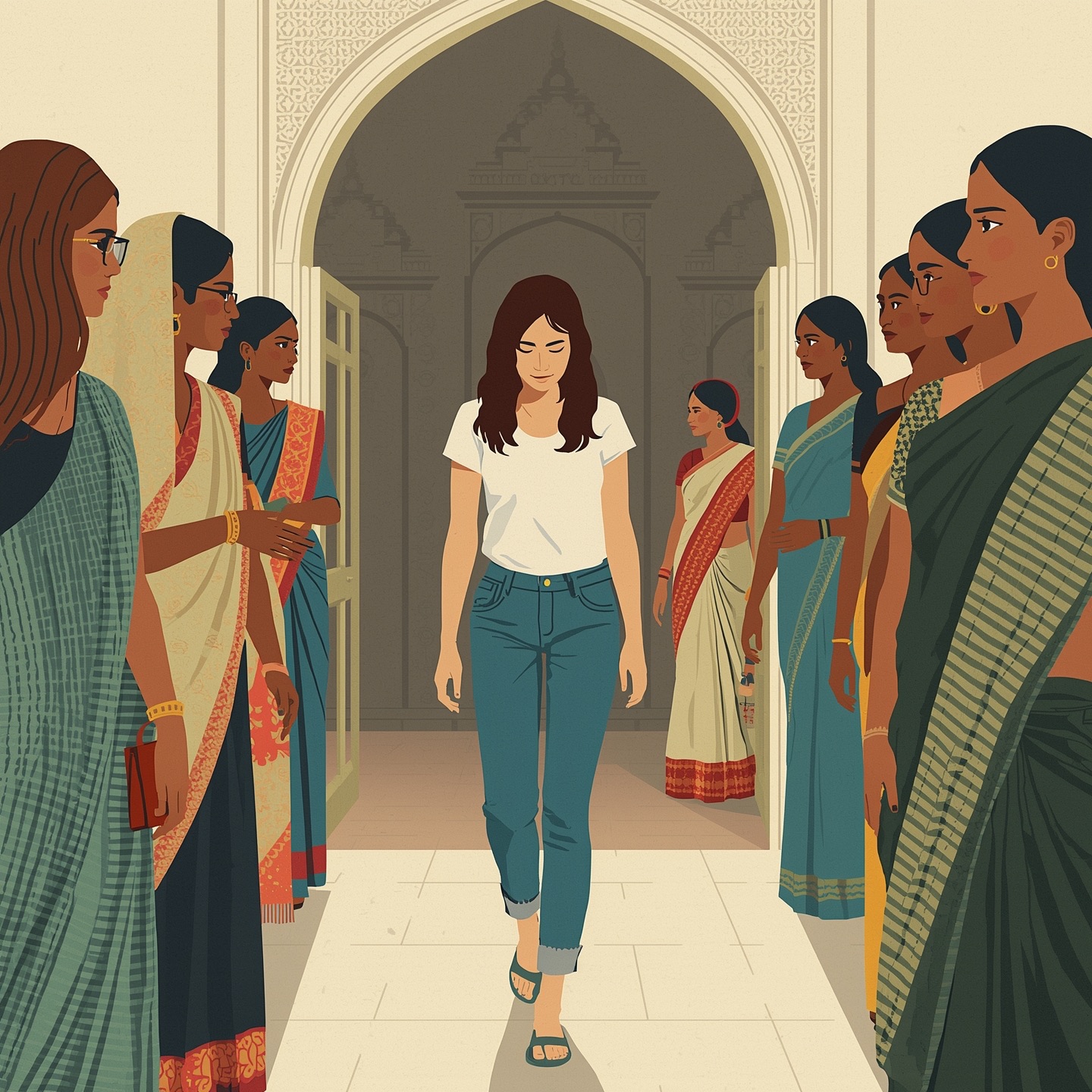
“I know. She doesn’t even wear a sari.”
Maria looked down at her scrubs. She worked twelve-hour shifts. She had two kids. She was doing the best she could.
That evening she asked one of the senior women if there was something she was doing wrong. The response was kind but telling: “Well, devotees usually dress more traditionally. It shows you’re serious about the process. And we haven’t seen you at the morning programs.”
Maria worked night shifts. Morning programs were impossible.
She kept coming for another few months, hoping something would change. It didn’t. The invisible wall remained exactly where it was. Eventually she stopped.
She still reads the books sometimes. Still chants occasionally. But she never went back to the temple.
The Invisible Test
Maria’s experience mirrors countless reports from people who’ve attempted to join religious communities. The details change, but the core dynamic persists. Not outright rejection. Something harder to name.
They’re always polite. They smile. They say hello. But certain people never quite make it in.
The mother who works full-time and comes straight from the office. The young man who asks too many questions. The family that can only attend occasionally. The convert who hasn’t mastered the Sanskrit pronunciation.
All sincere. All interested. All making genuine efforts. But none of them ever become part of the inner circle. Never invited to the real gatherings. Never included in the important conversations.
The message is unspoken but perfectly clear: you haven’t passed the test. And until you do, you’ll remain on the outside looking in.
What is this test? It’s not about knowledge. Maria was reading the books. It’s not about practice. She was chanting daily. It’s not about sincerity. She kept coming back for months despite the cold shoulder. The test is simpler and more arbitrary than any of that.
The Markers
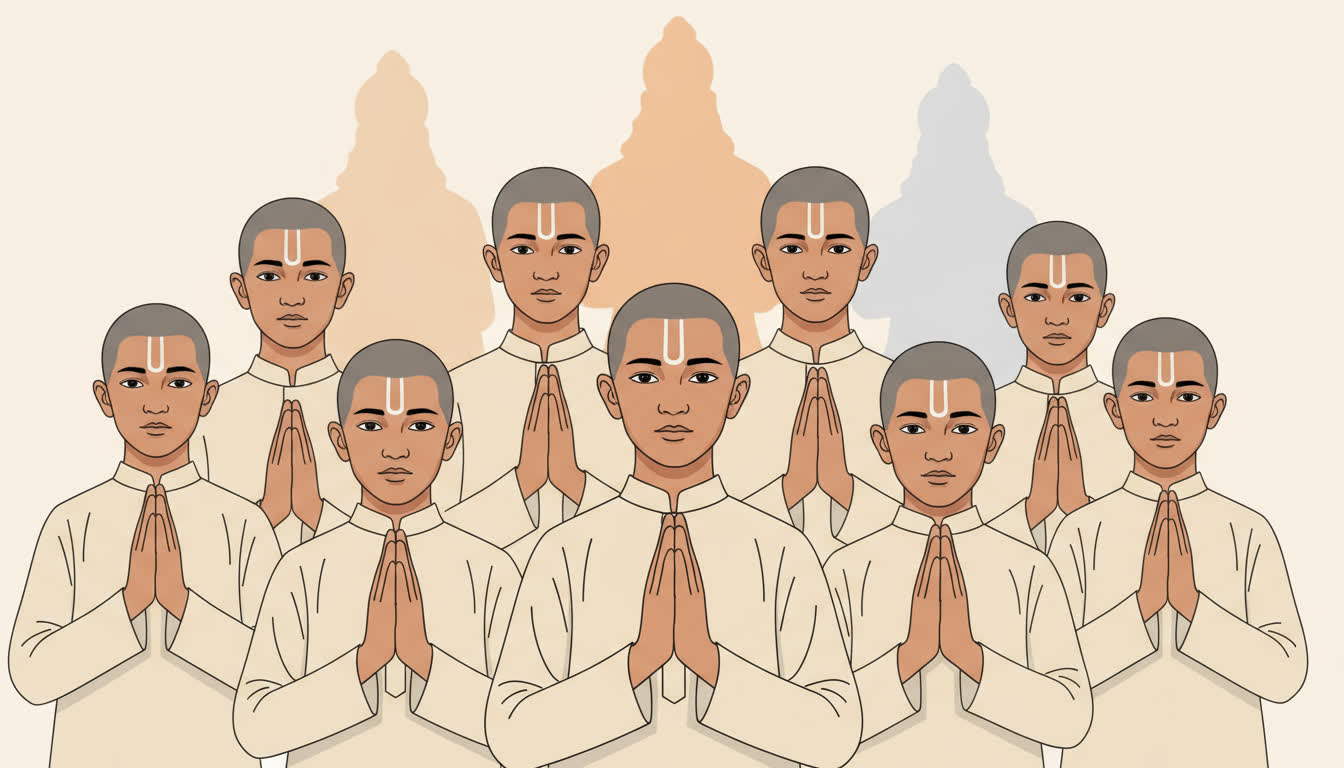
In these communities, spiritual advancement gets measured by a checklist of external markers. For women: sari, tilak applied correctly, hair covered, minimal jewelry. For everyone: number of rounds chanted, temple attendance frequency, Sanskrit pronunciation, knowing the “right” way to do everything.
And then there’s the name question.
“What’s your name?” seems innocent enough. But in ISKCON circles, it’s a litmus test. When you answer “Maria” instead of “Madhavi-devi,” the categorization is instant. No spiritual name means no initiation. No initiation means you’re not really one of them. The conversation shifts subtly. You’ve been placed in the outer circle before you’ve finished your sentence.
Those with spiritual names form an immediate bond. “Oh, you’re Radha-dasi? Who’s your guru? When were you initiated?” A whole shared language of belonging. Meanwhile, you’re standing there with your ordinary name, clearly marked as an outsider regardless of how many years you’ve been studying, how sincerely you practice, or how deeply the philosophy has transformed your life.
The spiritual name becomes a membership card. Without it, you’re perpetually a visitor, never quite a real member of the community. Never mind that initiation is supposed to be about an internal commitment and readiness. The name (the external marker) is what counts in the social hierarchy.
None of these things are wrong in themselves. The problem is when they become the test. When outward conformity determines who’s accepted and who stays perpetually on the outside.
What emerges is a two-tier system. The inner circle consists of “serious” devotees: those who look the part, know the codes, have proven their conformity. They get access to real community, real relationships, real support. Then there are the perpetual outsiders. “Interested” people who don’t look the part yet, or can’t, or won’t. They get polite tolerance but never real belonging.
You can stay in the outer circle for years. Decades. Forever. The standards keep shifting, the bar keeps moving, and there’s always something else you need to change to prove you’re “serious.”
How It Plays Out
Consider these scenarios:
The questioning convert reads voraciously. Attends every philosophy class. But he asks challenging questions about apparent contradictions, about historical context, about how to reconcile traditional teachings with modern understanding. The community sees: troublemaker, not humble enough, too intellectual. Potentially disruptive to others’ “simple faith.”
The part-time participant has demanding jobs and family obligations. Makes it to programs when she can, which isn’t every week. When she comes, she’s fully present. But her attendance is inconsistent. The community reads this as: not committed, worldly attachments, low priority on spiritual life. The inner circle is for those who show up to everything.
The imperfect practitioner tries to chant her rounds but sometimes misses days. She’s vegetarian but still learning all the rules about onions and garlic. She’s making genuine effort but hasn’t achieved perfection yet. The judgment: not disciplined, not following properly. Come back when you’ve got it all figured out.
In each case, the judgment is never stated outright. It’s all subtext. Polite smiles. Surface-level conversations. But never real acceptance.
Why It Happens
Most members in these communities aren’t deliberately excluding anyone. They’d be genuinely surprised to learn they’re doing it. That’s what makes the pattern so insidious.
Control through conformity: If you can make someone change how they dress, how they talk, when they show up, you can make them change other things too. The specific markers aren’t the point. Compliance is the point.
Identity through exclusion: Groups define themselves partly by who they’re NOT. “We’re not like those casual, worldly people who come in their work clothes.” “We’re not like those intellectuals who question everything.” The exclusion creates the identity.
Testing “sincerity”: The logic goes: “If they’re really sincere, they’ll conform. If they won’t make these simple external changes, how committed can they be?” But this confuses outward change with inner transformation. You can make someone wear the right clothes, say the right words, and show up to everything, and they’re still the same person inside. Meanwhile, someone making slower, deeper internal changes gets dismissed because the external markers aren’t there yet.
Protecting “purity”: There’s an unspoken fear that accepting people who don’t fully conform will dilute the community. Standards will slip. We’ll lose what makes us special.
But what you’re actually losing is people. Sincere seekers who could genuinely benefit from the teachings but can’t get past the arbitrary tests of “seriousness.”
The Contradiction
Here’s the irony. The scriptures these communities claim to follow say the opposite of what they practice.
Krishna doesn’t ask Arjuna about his clothes. He asks about his consciousness, his understanding, his willingness to act with wisdom. The Gita emphasizes seeing the divine in all beings, treating all with equal vision, inner transformation over outer show.
Vaishnava history is full of realized souls who didn’t conform to external standards. Haridasa Thakura was born Muslim. Rupa and Sanatana Goswami worked for the Muslim government. Various saints came from “low” castes or unconventional backgrounds. The tradition honors them precisely because spiritual realization transcends external categories.
ISKCON’s founder, Prabhupada, famously accepted Western hippies with long hair, wearing whatever they wore. He focused on getting them to chant, to understand the philosophy, to develop Krishna consciousness. The external changes came gradually, voluntarily, as internal transformation happened.
This isn’t an argument against traditional dress or temple standards. Those things have their place. The point is about sequence and acceptance. Prabhupada accepted people first, then supported their gradual transformation. Many communities today reverse this: they require transformation as the price of acceptance. That’s the problem. Not the standards themselves, but using them as gatekeeping mechanisms that exclude sincere seekers who haven’t yet arrived at a particular external presentation.
The Damage
How many people tried to engage with Krishna consciousness, encountered this gatekeeping, and walked away? We’ll never know. But each one is a loss.
When you select for conformity over sincerity, you get people who are good at looking the part. Not people who are actually transformed. You create communities of performance: everyone wearing the right clothes, saying the right things, going through the right motions, while inner transformation remains superficial.
For those who stay despite the exclusion, there’s lasting psychological damage. Never feeling fully accepted. Constant anxiety about “measuring up.” Hyper-awareness of every misstep. Inability to relax and just be. Eventually leaving, burned out and disillusioned.
The purpose of spiritual community is to support each other’s spiritual growth. To create an environment where people can explore, question, learn, and develop. When the community becomes a judgment factory, it fails at its core purpose.
What Real Community Looks Like
Real community accepts people where they are. Pants and all. It trusts that if the teachings are valuable, if the practice is genuine, transformation will happen organically.
What matters: Are you sincere in your seeking? Are you engaging with the teachings? Are you treating others with respect? Are you making efforts toward growth?
What doesn’t matter: Whether you wear pants or saris. Whether your tilak is perfectly applied. Whether you know all the Sanskrit words.
Real community invites people in. It says: “Come as you are. Learn. Grow. Explore. We’re here to support you.” It doesn’t say: “Prove you’re serious by changing everything about yourself first, and then maybe we’ll accept you.”
A healthy community has diversity. People at different stages, from different backgrounds, with different approaches. That diversity enriches everyone. Homogeneity might feel comfortable, but it’s spiritually stagnant.
What This Means For You
If you’ve experienced this polite exclusion, whatever form it took:
The failure isn’t yours. Whether it’s your work schedule, your clothing choices, your questions, your irregular attendance, or your incomplete grasp of ritual, none of these disqualify you from genuine spiritual engagement. The barrier exists in a system that has mistaken surface-level conformity for authentic transformation.
Your sincerity matters more than the markers. If you’re genuinely interested in the teachings, in spiritual growth, in understanding, that matters infinitely more than whether you fit their checklist. Deep internal change takes time. Real seeking sometimes looks messy from the outside.
You deserve real community. Not conditional acceptance. Not perpetual outsider status. Actual belonging, actual support, actual spiritual friendship. Community that meets you where you are and supports your growth. Not community that demands you arrive already perfected according to their standards.
There are better communities. Not all ISKCON groups operate this way. Some have genuine openness and acceptance. And there are other spiritual communities, other teachers, other paths where sincere seeking is honored over superficial conformity.
Trust your own path. If the philosophy speaks to you but the community doesn’t, you can engage with the teachings in your own way. Read, practice, explore. You don’t need anyone’s permission to have a spiritual life.
Real Acceptance
Here’s what these communities miss.
A person in work clothes is no less capable of spiritual realization than someone in traditional dress. Someone who asks challenging questions can achieve deeper understanding than someone who accepts everything blindly. Someone who practices imperfectly but sincerely is further along the path than someone who performs perfectly but mechanically.
Spiritual development happens in consciousness, not in conformity to external markers.
Communities that can’t see past the superficial standards have lost sight of the entire point. They’ve turned spirituality into tribalism, transformation into performance, and belonging into a test you can never quite pass.
Real spiritual community recognizes the divine in all beings. Whatever they wear, however they speak, whenever they can participate, and wherever they are on their journey.
Everything else is just gatekeeping dressed up as standards.