
Lakshmi had been driving for forty minutes when she pulled into the friend’s driveway. She had come for one reason. A visiting sannyasi was speaking in the living room tonight, and she had decided, somewhere between her son’s last appointment and now, that she was going to ask him for help.
She had not told anyone what she was carrying. Six months ago her son, thirty years old, was diagnosed. The treatment had been brutal in the way these treatments are. He had survived it so far. What he had not survived was what it had done to his ability to be in the same room with her. He had stopped picking up the phone past nine. He had stopped finishing meals when she was watching. He could not bear his fear in front of her, and so he had begun, quietly, to make her absent from the parts of his life where the fear lived.
She wanted to know how to stay close to him without making it worse. That was the question. That was the only question.
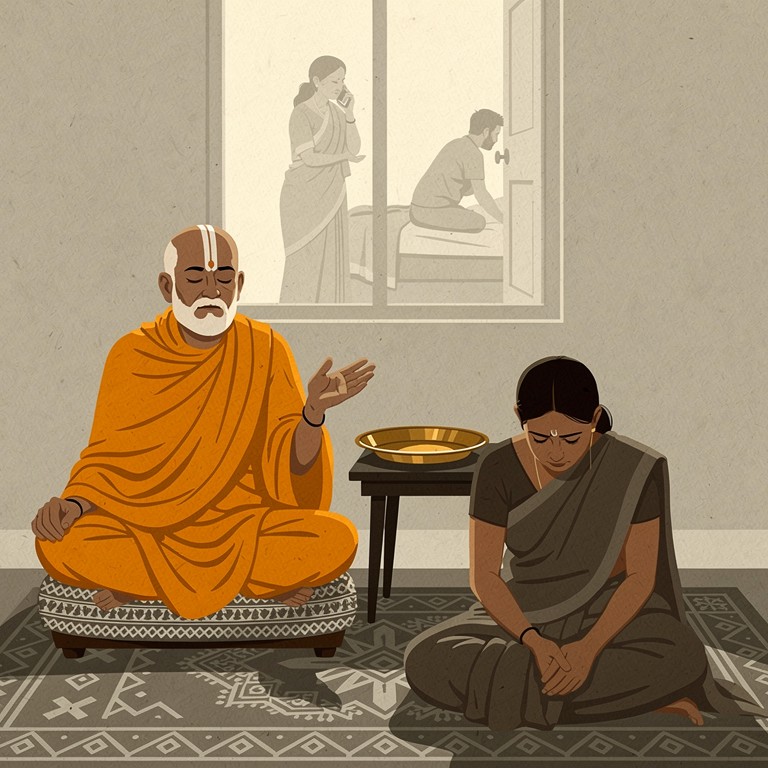
The lecture was normal. Fruit was passed on a silver thali. Q&A opened. The host’s wife asked something tangential first, almost lit up by the chance to speak. Lakshmi waited. When the room quieted she raised her hand and told them about her son. Her voice caught once. She finished with the question she had rehearsed in the car. What should she do?
The sannyasi nodded kindly. He said, “It is his karma. From a previous life. The body suffers, but you are not the body. The soul is eternal. Chant for him.”
Then forty minutes on samsara, the wandering soul, the futility of bodily attachment. Phones glowed quietly in laps. The host beamed at the elevation of the discourse.
Lakshmi said “Hare Krishna,” touched the host’s wife’s hand on the way out, and walked to her car. She did not cry until she was on the highway. By the time she reached her exit, she had drawn a quiet conclusion that would shape the rest of her son’s life. Maybe loving him so much was the mistake all along.
She had not been freed of her grief. She had been talked out of feeling it. The doctrine that should have given her courage to fight for her son had given her doctrinal cover to step further away.
The Doctrine That Was Never a Wall
What happened in that living room was not unusual. Some version of it is happening tonight in another devotee’s home, in another city, with a different mother and a different question and the same outcome. Profound concepts, karma, the eternal soul, “Krishna’s plan,” are deployed not to strengthen the asker but to silence the asking.
The seduction of this move is its altitude. It sounds elevated. It feels transcendent. It costs the speaker nothing. Caring is hard. “It is his karma” is an off-ramp from the hard work of caring, and the off-ramp is paved in scripture, which means no one in the room is allowed to question whether they are actually traveling on it.
But the same teaching meant to deepen compassion is being used here to anesthetize it. Same words. Opposite function.
This is not an article against the doctrine. The doctrine is fine. This is an article against what we are doing with it on the cushion at the front of the room, and what happens to the people who came in carrying something real.
The Same Frost in Different Rooms
The pattern shows up everywhere a doctrine is louder than a person.
A wife, gently, after the second miscarriage, tells her husband the loss was her karma and they should not dwell on it. He sits with the sentence in his mouth and does not know what to say. Two years later he will tell a friend that his wife stopped being his wife on the night she said that. He will not tell her.
A daughter, in the same kind of voice, tells her own mother to “stop being so material” about the cancer diagnosis the family received last week. The phrase travels well. It costs the speaker nothing. The mother goes quiet for a long time and then changes the subject.
A girl of twelve, at a youth class, has been told that empathy is the foundation of bhakti. Now she is sitting in temple and she has heard the verse “the wise lament neither for the living nor the dead.” She raises her hand at a family program. She asks how both can be true. The answer she receives is twenty minutes of context. Kshatriya duty, the geography of Kurukshetra, Bhishma’s vow. She nods. She decides, more quietly than anyone in the room notices, that the philosophy is not interested in her.
These are different rooms with the same logic. Doctrine deployed where presence was wanted. The wife learned this from someone. The daughter learned it from someone. The teacher who answered the twelve-year-old learned it from a longer line, and the speakers at the front of that line have been giving the same kind of answer for forty years to people whose questions were never quite the questions they answered.
Above the family program is the sannyasi. Above the sannyasi is the institution. The frost arrives at the bottom of the chain because it has been falling from the top.
The Teacher Who Was Promoted for His Detachment
What happened in Lakshmi’s living room was not a bad man doing a bad thing. It was a wounded man in an inherited role, doing what the system trained him to do. Until we see what is actually happening under the doctrine, the frost keeps falling.
The man on the cushion has, in most cases, his own version of an early story. He often entered an ashram young, sometimes very young, and survived in that environment by becoming exceptionally good at the one thing the environment rewarded. The reproduction of philosophy. What was already his survival skill in childhood became his profession in adulthood. The applause he received at thirty for delivering an immaculate purport was the same warmth he had been chasing since he was eight.
The institution he serves selects for this. Men who would have wept with the grieving mother are passed over for sannyasa. Men who can deliver forty unbroken minutes of cosmology while she weeps in the third row receive more invitations. Over forty years the system filters, then filters again, until those holding the most prominent seats are precisely the men whose own feelings are the most carefully managed.
What this man has, by sixty, is real. Encyclopedic command of scripture, fluency in Sanskrit, decades of austerity, renunciation of comforts most people cannot imagine giving up. None of it is fake. But the part of him that was never developed is also real, and it is the part that should have been listening to Lakshmi.
There is a clinical word for what he is doing in the moment her question lands. He is reaching for intellectualization, the oldest defense in the catalogue, the one that converts the unbearable feeling in the room into a cool topic that can be lectured about. Lakshmi’s grief threatens to make him feel something. The forty minutes of cosmology are how he stays away from feeling it. He has done this his whole life. It has been rewarded his whole life. He often genuinely believes the lecture is a higher offering than the silence and the held hand would have been. He has spent his whole life inside a system that taught him so.
He is not a villain. He is a man who was once a sensitive child in some early room, who learned to manage his own pain by becoming useful and impressive, and who has been promoted, and promoted, and promoted, for the very adaptation that now keeps him from doing the work the seat actually requires.
The Qualification That Got Dropped
The Sri Caitanya-caritamrta (Madhya 22.78-80) lists the qualities of a Vaishnava in plain order. Among them, in plain Sanskrit: kripalu (merciful), karuna (compassionate), maitra (friendly), sarvopakaraka (working for everyone’s welfare). Not optional. Listed.
The Srimad Bhagavatam 11.3.21 names the two requirements of one fit to be approached as a guru. Shabde pare ca nishnatam, fluent in scripture and realized in the Absolute, and upashamashrayam, having taken shelter of peace. A man whose words make a worried mother smaller than she came in has not taken shelter of peace. He has taken shelter of cleverness.
The tradition knew exactly which qualities would be the first to be quietly dropped when an institution started rewarding spectacle. The list is a check on the institution we built. It is not slander to read it back to ourselves.
A man can wear saffron for forty years, accept thousands of disciples, give a hundred lectures a year, and still be unqualified by the tradition’s own standards. Disciple count is not a qualification. Saffron is not a qualification. The list is shorter and harder than the institution we have learned to bow to.
Prabhupada wept reading about Lord Caitanya. He wept when his disciples left their bodies. He wrote letters anxious about marriages, about children’s health, about families. He intervened when he saw mistreatment. The tears were not weakness. They were the qualification.
A reader’s tool, plainly. When a teacher’s philosophy makes the questioner walk out smaller than they came in, you are watching a missing qualification, no matter how impressive the sentences were. The tradition gives you permission to notice.
What the Tradition Actually Holds
The doctrine being misused in Lakshmi’s living room comes from somewhere. So does its correction.
The verse the twelve-year-old was confused by — that the wise lament neither for the living nor the dead — is medicine for a specific kind of false grief, not anesthesia for real love. Arjuna was not callous; he was paralyzed by feeling. Krishna was correcting his philosophical error, his belief that killing his elders would destroy them. The next seventeen chapters tell Arjuna to fight, to act, to engage with the world he was tempted to flee. The verse never licenses callousness toward a son sitting in a quiet bedroom not answering his phone.
A few chapters later, Krishna describes the devotee He calls dear: one who is a kind friend to all living entities, one for whom no one is put into difficulty. A mother who walks out of a satsanga smaller than she came in has been put into difficulty. The doctrine in the room failed Krishna’s own description of His dear devotee.
And the Vaishnava ideal at its purest is para-duhkha-duhkhi — one whose own heart aches because another’s heart aches. Prahlada Maharaja, offered any benediction by the Lord Himself, refused to be liberated alone. He could not leave the suffering souls of this world behind and call himself free.
This is the precise opposite of “it is his karma.”
Toward Meeting the Questioner
The fix is not philosophical. It is not another verse, another framework, another institutional reform. It is much smaller and much harder. It is the willingness, in the moment, to feel what is in front of you before you reach for what you know.
For the teacher, the sannyasi, the senior speaker. The seat you are occupying is not measured by how clean your purport was. It is measured by what the questioner left with. Listen for the question under the question. When a mother asks about karma, she is not asking about karma. She is asking how to stay close to her son. Answer the question she actually asked. The philosophy will keep until later. It always does.
For the rest of us sitting in the room while a question gets buried in cosmology — trust your perception. Notice that the questioner has gone smaller, not larger. The discomfort you feel is not your own lack of advancement. It is the sound of a missing qualification, audible to anyone whose own heart has not yet been fully managed. The tradition gives you permission to notice. You are not failing as a devotee for wanting an answer that touched the asker.
And when the phrase begins arriving in your own mouth — “it is her karma”, “you are not the body”, “this is Krishna’s plan” — notice that it is showing up not after you have felt the suffering in front of you, but instead of feeling it. The phrase travels well because it costs nothing. Cost something. Stay in the room. Sit with the person until you have actually understood what they are carrying. Then, if the philosophy still wants to come out, let it come out as the next sentence after presence, not as the substitute for it.
The test is one sentence. Did the person I just spoke to leave larger, or smaller? If smaller, the answer was wrong, no matter how scripturally accurate it was. The mark of a Vaishnava is a soft heart, not a hard one.
The Same Evening, Differently
Imagine the same evening. Same fruit on the thali. Same chairs. Different answer.
The sannyasi pauses when Lakshmi finishes. He does not reach for the verse. He says, “Sit down. Tell me about him. What does he love? Who can go to him this week?” He listens. He asks her what she needs, because she is also a soul carrying weight. Then, gently, after presence has been established, he frames the karma teaching as something to hold her up rather than to wave her away. He says, “Your love for him is not your mistake. Krishna gave you that love so you would not abandon him. Do everything you can. The result belongs to Krishna.”
She walks out larger, not smaller. She drives home and calls her son. The doctrine has not changed. It has done what it was always meant to do.
That is the only thing we have to recover. Not the philosophy. The philosophy is fine. Just the willingness to stay in the room with each other long enough that the philosophy does its job.