

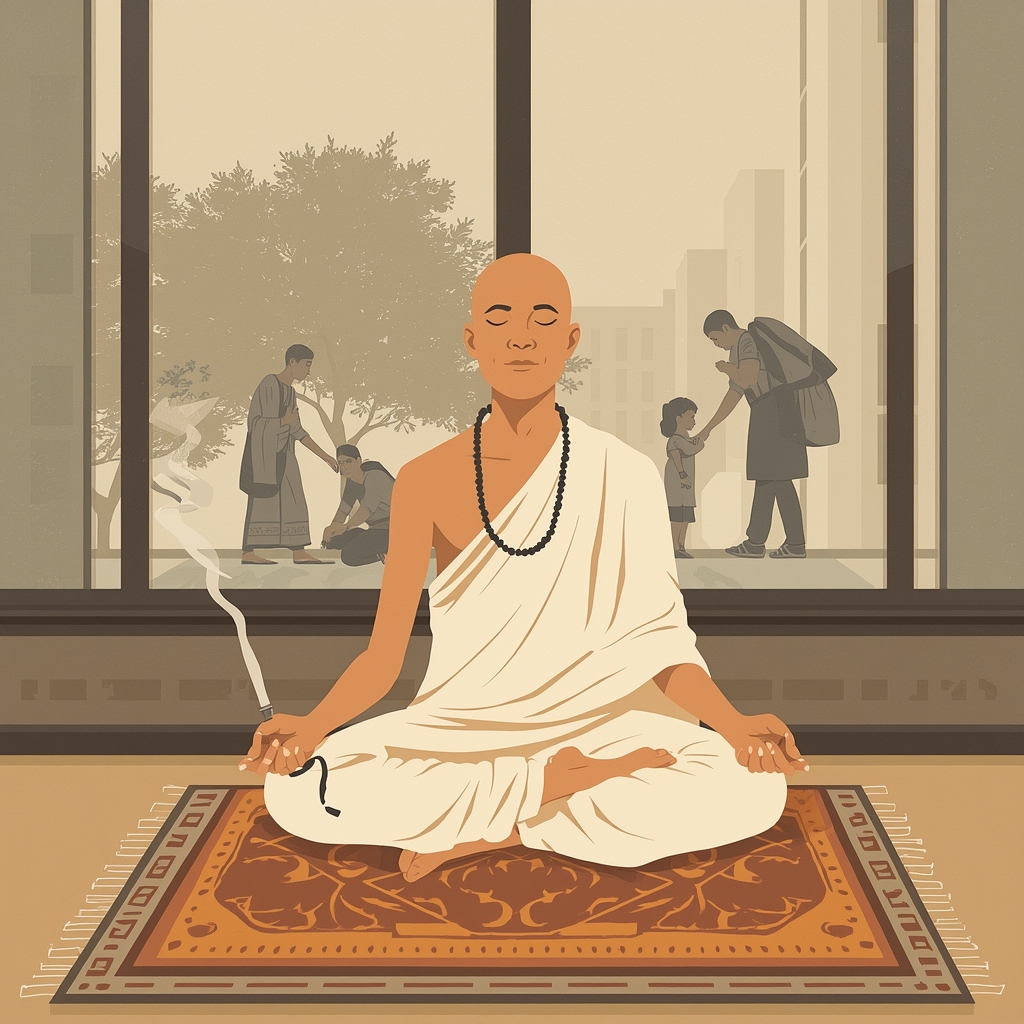
Madhava walked past the homeless man every morning on his way to the temple. The same corner. The same cardboard sign. The same hollow eyes. His temple friend Karuna once suggested organizing food distribution there. Madhava’s response came quickly, almost reflexively: “The world doesn’t need reform. Everything is under God’s control. That man is getting exactly what his karma dictates. We should focus on our own purification.”
It sounded sophisticated. It felt transcendent. Karuna couldn’t argue with it.
But something had shifted in Madhava. He’d found a philosophy that allowed him to walk past suffering without the discomfort of actually caring. He could ignore problems, call it detachment, and feel spiritually elevated for doing so. The world’s course needs no intervention, after all. He’d read that somewhere.
Within six months, Madhava stopped attending community outreach. Too mundane. He stopped helping newer recruits. Too material. He spent more time reading philosophy and less time applying it. When the temple president asked why he’d withdrawn from service, Madhava had his answer ready: “I’m focusing on the real work. Inner reform. Self-purification. The world will take care of itself.”
And he believed it. That’s what made it dangerous.
The Seduction of Cosmic Fatalism
There’s a philosophy circulating in spiritual circles that sounds deeply enlightened but functions as spiritual sedative. It goes something like this: The world operates perfectly under divine guidance. Every event, down to the movement of a hair, follows God’s plan. Anyone who thinks they need to reform the world is themselves in need of reform. The only real work is adjusting your own vision through the mercy of the Lord.
The reasoning appears airtight. If God controls everything, then working to change anything is presumptuous. If every individual acts without independent will, driven by forces beyond their control, then holding people accountable is spiritually naive. If the world follows its perfect course, then activism, charity, social reform, or even basic compassion become unnecessary distractions from “real” spiritual life.
This philosophy is seductive for several reasons:
It provides instant relief from the weight of caring. Suffering exists everywhere. Injustice is persistent. The problems are overwhelming. This philosophy offers an elegant escape: It’s not your responsibility. It never was.
It makes passivity look like realization. You’re not being lazy or callous. You’re being transcendent. You’ve understood what others haven’t: the futility of trying to fix what’s already perfect.
It requires no actual sacrifice. Unlike genuine spiritual service, which demands your time, energy, and resources, this philosophy asks nothing of you except to sit back and watch. You can call it “seeing God’s hand” while your hands remain idle.
It provides philosophical ammunition against anyone who challenges your inaction. When someone suggests you should do something, you can deploy seemingly unassailable logic: “You think you know better than God? You think the world needs your intervention?”
But here’s what this philosophy actually is: spiritual bypass masquerading as mature understanding.
When Philosophy Becomes Paralysis
This misapplication shows up in predictable patterns:
The Withdrawn Spiritualist:
Ramesh was once active in temple management, community outreach, and altar worship. Then he had his “realization.” He stopped engaging with temple politics. Stopped trying to improve procedures. When newer devotees struggled with the community’s internal problems, Ramesh would say: “These issues will resolve themselves according to God’s plan. Your real work is praying attentively.”
He’d transformed from a contributing member to a philosophical ghost. Present physically, absent functionally. And he felt good about it.
The Disengaged Parent:
Lalita noticed her teenage son drifting away from spiritual practice. His friends were rough. His grades were dropping. When her husband suggested they intervene more actively, Lalita quoted scripture: “Everyone has their own path. God guides from within. We can’t force anyone. The world needs no intervention.”
Six months later, her son stopped coming to the temple entirely. But Lalita had her philosophy to comfort her: It’s all God’s plan.
The Passive Observer of Abuse:
Bhakta Michael knew something wasn’t right in how the senior devotee spoke to women in the community. Others had noticed too. Someone suggested they should address it formally. Michael’s response: “Who are we to judge? That devotee is acting according to his nature under God’s direction. Real devotees see everyone as instruments of the Lord. The problem is our vision, not his behavior.”
The abuse continued. Michael’s philosophy provided cover.
The Indifferent Citizen:
Priya lived in a community plagued by corruption, environmental destruction, and growing inequality. When a group of devotees discussed organizing community service initiatives, Priya dismissed it: “The world is already perfect as God designed it. These problems serve a purpose in the cosmic order. We’re not here to fix society; we’re here to transcend it.”
Her transcendence looked a lot like privilege defense.
Why We Mistake Fatalism for Faith
This philosophical error persists because it serves powerful psychological needs.
First, it eliminates the anxiety of responsibility. If you’re responsible for nothing beyond your own chanting, life becomes dramatically simpler. No need to navigate complex ethical situations. No need to weigh competing goods. No need to sacrifice comfort for others’ welfare. Just focus on your rounds and let God handle everything else.
Second, it provides moral high ground without moral action. You can feel superior to those “trying to reform the world” while doing absolutely nothing yourself. Your inaction becomes evidence of your advanced realization.
Third, it protects against failure. If you never try to change anything, you never fail to change anything. Your philosophy guarantees you’ll never face the disappointment of working hard for results that don’t come.
Fourth, it resolves the tension between spiritual philosophy and human compassion. When you see suffering, something in you wants to respond. But if you’ve been taught that material welfare doesn’t ultimately matter, how do you justify caring? This philosophy provides the answer: You don’t. Caring itself becomes a sign of material attachment.
Fifth, it allows selective application. Notice how spiritualists who hold this philosophy still go to doctors when sick, still lock their doors at night, still teach their children to look both ways before crossing the street. They don’t actually believe human action is irrelevant. They just apply that belief selectively to avoid inconvenient obligations.
The psychology is clear: This isn’t transcendence. It’s convenience wearing transcendence’s clothes.
The tradition teaches something far more demanding than passive observation: active devotional service that engages the world skillfully, compassionately, and with detachment from personal gain.
The Price of Pretend Transcendence
This philosophy exacts real costs.
At the personal level, it produces spiritual stagnation. Service is where devotion deepens. Srila Rupa Goswami’s definition of bhakti in Bhakti-rasamrita-sindhu explicitly includes engaging everything in Krishna’s service. Remove engagement, and you remove the medium through which devotion develops.
Devotees who adopt this philosophy typically show a predictable pattern: Initially enthusiastic practice gradually becomes mechanical. Rounds get completed but with wandering mind. Reading happens but without application. Community involvement decreases. Eventually, what’s left isn’t advanced realization but comfortable isolation.
At the institutional level, it creates irrelevance. When devotees refuse to address real problems, claiming “Krishna will handle it,” institutions decay. Abuse continues. Inefficiency persists. Corruption spreads. And when the public sees devotees responding to serious issues with “the world is already perfect,” they correctly identify such statements as disconnected from reality.
ISKCON’s effectiveness as a preaching movement depends on devotees caring enough about people’s actual lives to engage meaningfully. The “no intervention needed” philosophy undermines this entirely.
At the cultural level, it produces exactly what Lord Chaitanya’s movement aimed to counter: a spirituality that’s divorced from ethical action, unconcerned with suffering, and ultimately irrelevant to anyone seeking practical guidance for living.
The Bhagavatam’s description of genuine spirituality includes real-world transformation: devotees become naturally compassionate, truthful, clean, grave, self-controlled, and beneficial to all living beings. These aren’t mere internal states. They manifest in behavior that improves communities.
The philosophy we’re examining makes such transformation impossible by removing the field where it develops: engaged service.
Seeing Rightly
Here’s what that original Spanish text was actually pointing toward, before it gets misapplied:
“Our vision of the world is what demands adjustment.”
Yes. Absolutely yes. But adjusting your vision doesn’t mean closing your eyes.
Seeing Krishna’s hand in everything doesn’t mean seeing human action as irrelevant. It means seeing human action as the instrument through which Krishna’s plan unfolds. You’re part of that plan. Your choices matter. Your service matters. Your compassion matters. Not despite Krishna’s control, but because of it.
Prabhupada explained this perfectly: Krishna is driving the chariot, but you have to pick up the reins. The electricity is there, but you have to flip the switch. The guru and Krishna will help, but you must become willing to be helped by acting.
Real vision adjustment means seeing opportunities for service everywhere. The homeless man on the corner isn’t “getting what he deserves” beyond your jurisdiction. He’s Krishna giving you an opportunity to serve. The dysfunctional temple community isn’t “perfect as is.” It’s your field of devotional action. The suffering child isn’t “just karma.” She’s Krishna testing whether your philosophy translates into compassion.
When “Krishna enters your ears” through the holy name from a genuine devotee, you don’t stop caring about the world. You care more, but differently. You care with detachment from results but not from action. You care with understanding that you’re an instrument, not the controller, but an instrument that must function properly to fulfill its purpose.
Bhaktivinoda Thakura didn’t write “Krishna controls everything so I’ll do nothing.” He wrote hundreds of books, established communities, reformed practices, fought against abuse, and worked tirelessly to spread Lord Chaitanya’s mission. That’s what “seeing rightly” produces.
Hands That Serve
If you recognize yourself in these patterns, here’s the path forward:
First, distinguish fatalism from faith. Faith means trusting Krishna’s ultimate goodness while engaging fully in prescribed duty. Fatalism means using Krishna’s control as justification for your passivity. One requires courage. The other provides comfort.
Second, examine your service record. Not your philosophical sophistication. Not your realization claims. Your actual service. Are you giving more or less of yourself to Krishna’s mission than you were a year ago? That’s the test.
Third, remember Prabhupada’s standard. He repeatedly said: “Work as if everything depends on you; pray as if everything depends on Krishna.” Not “do nothing because Krishna does everything.”
Fourth, engage one concrete practice of compassionate action. Feed people. Teach someone. Clean something. Fix something that’s broken. Help someone struggling. Do it not to reform the world but as bhakti, as devotional service, as your offering to Krishna through engagement with His energy.
Fifth, stop using philosophy to avoid responsibility. If your spiritual beliefs make you less responsive to suffering rather than more, those beliefs need adjustment, not the suffering people around you.
Sixth, seek instruction from devotees who serve. Not devotees who philosophize about why service isn’t necessary. Find practitioners whose spiritual life produces tangible benefit for others, and learn from their example.
Finally, read the Gita again. All of it. Notice how much of Krishna’s instruction to Arjuna is about acting properly, not about withdrawing from action. Notice that Krishna spends eighteen chapters convincing Arjuna to fight, to engage, to fulfill his duty, not to transcend it.
The world might not need the revolution you’re imagining. But it needs your devotional service. Krishna placed you in your specific circumstances with your specific abilities for a reason. Those aren’t obstacles to your spiritual life. They’re the material of it.
The Real Work
Yes, the only real work is self-reform. But self-reform isn’t achieved through philosophical contemplation while the world burns around you.
Self-reform happens through service. Through facing difficulties. Through caring for God’s energies even when they’re disguised as uncomfortable situations and inconvenient people. Through discovering that your transcendence grows not by disconnecting from the world but by engaging it with devotion.
The world doesn’t need your grandiose plans for revolution. It needs your hands, your time, your attention, your compassion, offered as service to God through service to His parts and parcels.
That homeless man on the corner? That struggling temple community? That suffering you’re philosophically sophisticated enough to ignore? Those are your field of devotion.
The test of your spiritual realization isn’t what philosophy you can quote. It’s whether your philosophy produces genuine detachment with active compassion, or just produces sophisticated-sounding justifications for doing nothing.
Madhava eventually learned this. It took a crisis. His own child became seriously ill, and suddenly the “world needs no intervention” philosophy collapsed. He wanted doctors. Medicine. Prayer. Action. Everything he’d been teaching himself was unnecessary.
In that hospital, watching his child suffer, the realization came: His philosophy had been protecting him from the discomfort of caring. He’d called it transcendence, but it was just fear wearing wisdom’s mask.
He’s serving differently now. Still chanting. Still studying. But his hands move. His heart opens. His philosophy includes action.
That’s what adjustment of vision actually produces. Not paralysis. Not indifference. Not cosmic fatalism dressed as faith.
Active devotion. Engaged compassion. Service offered through whatever means God has placed in your hands.
The world might not need your revolution. But it needs your devotion.
And devotion acts.