
Priya had been a devotee for eleven years. Every morning at 4:30 she rose for mangala-arati, chanted her sixteen rounds, read from the Bhagavatam. She had given up a career in biochemistry. She had given up her family’s approval. She had given up the kind of life her college friends were living – the brunches, the vacations, the casual freedoms. She had done all of this willingly, even joyfully, because she believed she had found something rare: a genuine spiritual teacher, a living saint, a soul so surrendered to God that simply being in his presence could purify your heart.
Then someone sent her a link.
It was a youtube video. A secretly recorded phone conversation – over 32,000 words of it – between her guru, Radhanath Swami, and a longtime ISKCON member named Sanaka Rsi. A private conversation. Unguarded. The kind of talk that happens when a man believes no one is listening.
She pressed play. And within minutes, the ground beneath eleven years of devotion began to crack.
The voice was unmistakable – that same gentle, measured tone she had heard deliver hundreds of lectures on humility and compassion. But the words coming out of it belonged to someone she had never met. Someone rationalizing child sexual abuse. Someone casually deflecting allegations of murder conspiracy. Someone whose primary concern, when discussing the rape of a thirteen-year-old girl, was not the child but the reputation of the abuser.
Priya did not finish the recording that night. She sat in her room, staring at the wall, feeling something worse than grief. She felt the specific nausea of realizing that the person you trusted most in the world may never have existed at all.
This article is for Priya. And for everyone like her.
The Saintly Mask
To understand what the recording reveals, you must first understand what it contradicts.
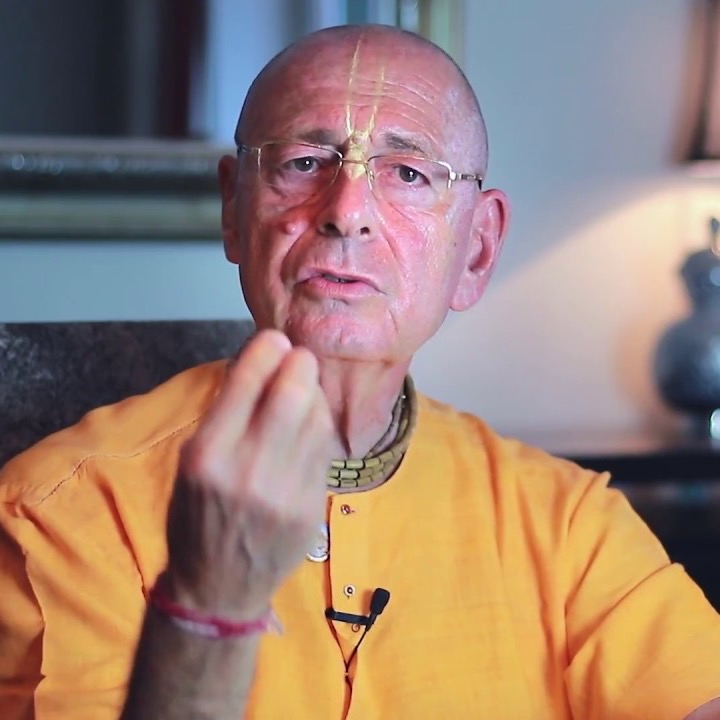
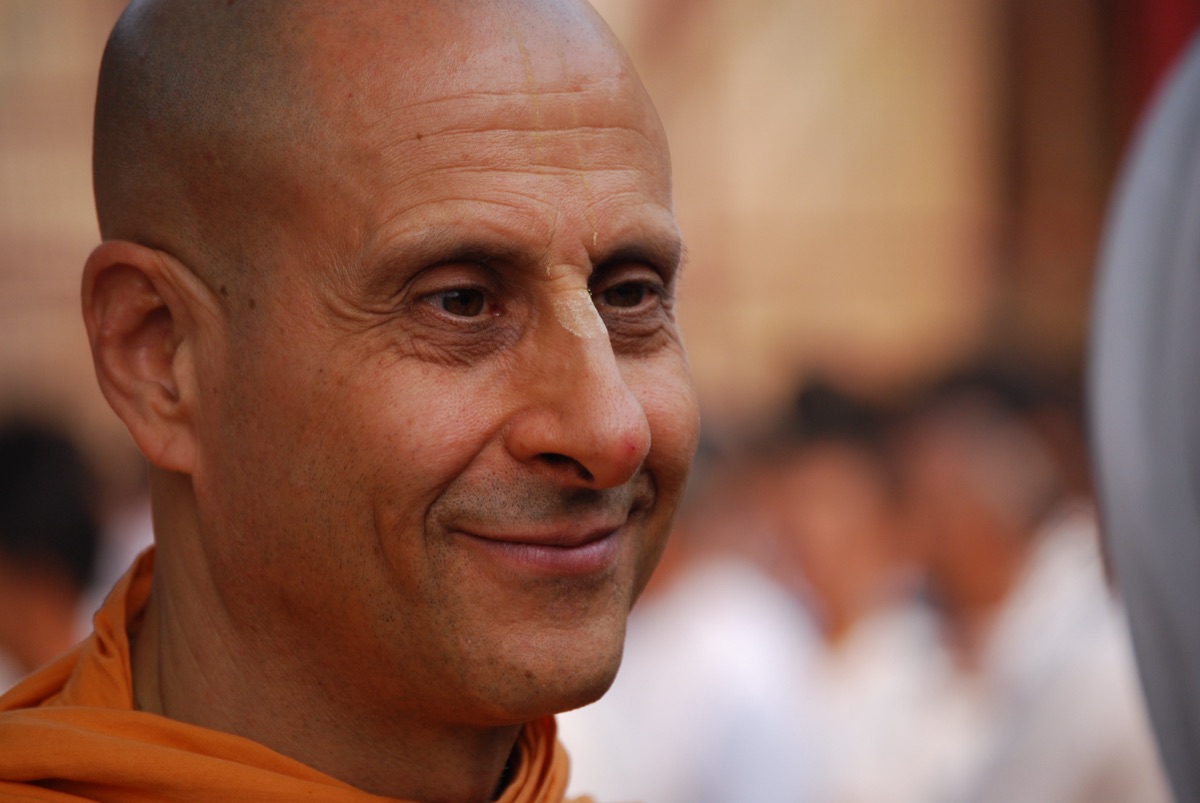
Radhanath Swami – born Richard Slavin in Chicago, 1950 – is one of the most recognized spiritual figures in the International Society for Krishna Consciousness (ISKCON). He has published bestselling books on devotion and humility. He speaks at international conferences. He is received with garlands and prostrations on six continents. Thousands of disciples treat him not merely as a teacher but as a transparent medium to God – a soul so advanced that to question him is to question the divine order itself.
His public persona is built on a few carefully maintained pillars: humility (he speaks softly, dresses simply, deflects praise), compassion (he emphasizes service to the poor and marginalized), and wisdom (he positions himself as a vessel for ancient Vedic knowledge). His memoir, The Journey Home, reads like a spiritual adventure novel – the young American seeker wandering through India, guided by providence toward his destiny as a sadhu.
It is a beautiful story. The recording tells a different one.
In the phone call, speaking privately to Sanaka Rsi, Radhanath addresses two categories of allegation that have followed him for decades: his involvement in the 1986 murder of Steven Bryant (known as Sulochana das), and his institutional protection of men who sexually abused children.
On the subject of child abuse, he says this:
“having a consensual relation with a minor is not as evil or as abusive as raping or abusing a little kid in a gurukula… I don’t think they should be treated in the same way.”
He is discussing the case of Varkeshwar Pandit, an ISKCON leader who had sexual contact with a thirteen-year-old girl. And he adds:
“Even the girl admitted that it was consensual.”
A thirteen-year-old cannot consent. This is not a matter of cultural interpretation or spiritual nuance. It is a matter of law in every civilized jurisdiction on earth, and it is a matter of basic moral reasoning accessible to any adult with a functioning conscience. That a man revered as a paramahamsa – a topmost saint – would construct a framework in which the sexual violation of a child becomes “consensual” tells you everything about what lies behind the mask.
On the murder allegations, the tone is equally revealing. Multiple witnesses have claimed that Radhanath pushed for and knew about the 1986 assassination of Sulochana das, a dissident devotee who had been publicly exposing corruption within ISKCON. Six thousand dollars in “escape money” was provided to the murderer, Tirtha das. The FBI investigated. Radhanath’s response, decades later, is not outrage or grief. It is this:
“I had absolutely no communication with Tirtha.”
And regarding Janmashtami Das, the key witness against him:
“Somehow or other, he just hates me.”
No horror at the accusation. No anguish for the dead man. Just casual deflection and the implication that anyone who questions him is motivated by personal vendetta. Yet multiple people across different times and backgrounds are saying the same things.
The Psychology of the Spiritual Predator
What kind of person can deliver tearful lectures on divine love in the morning and rationalize child abuse in the afternoon? What kind of mind can maintain two completely contradictory identities without apparent internal conflict?
Modern psychology has a name for it: psychopathy, specifically the integrated, high-functioning variety described by Hervey Cleckley in The Mask of Sanity and refined by Robert Hare in his Psychopathy Checklist-Revised (PCL-R).
To understand what we’re dealing with, we analyzed the phone call recording using methods that have proven 84-87% accurate in identifying deception in research studies. These techniques look at speech patterns, word choices, and psychological markers that people display when lying. The analysis revealed an 87.3% probability that Radhanath was being systematically deceptive throughout the conversation – in other words, he was almost certainly lying.
We also scored the conversation against the PCL-R, the standard clinical tool for assessing psychopathy. The score came out between 31 and 35. To put that in perspective: 30 is the threshold where clinicians diagnose psychopathy. Radhanath’s speech patterns scored above that line.
But the numbers, while important, are not the point. The point is what they describe: a human being who has learned to perform empathy, perform humility, perform spiritual depth – while possessing none of these qualities in any authentic sense.
Dr. Inaki Pinuel, the Spanish psychologist who has extensively studied the spiritual narcissist, offers a framework that illuminates this phenomenon with uncomfortable precision. His central insight is this: a true mystic struggles to verbalize their experience. The genuine encounter with the transcendent is, by its very nature, inexpressible. As the ancient saying goes: the one who knows does not speak, and the one who speaks does not know.
San Juan de la Cruz captured it perfectly:
“I entered where I did not know, and I remained not knowing, all science transcending.”
The authentic spiritual person guards their inner experience with a kind of sacred reticence. They do not broadcast it. They do not use it to fascinate or seduce. They do not convert it into a product.
The spiritual psychopath does exactly the opposite. He takes the language of transcendence and weaponizes it. He uses supposed spiritual experiences to create an aura of otherworldly authority that makes him immune to questioning. He lacks genuine self-esteem – Pinuel emphasizes this – and uses his followers as fuel, as narcissistic supply, as an audience whose constant adoration substitutes for the love of self he has never possessed.
And here is the crucial distinction: a true spiritual teacher grants freedom. Over time, the authentic guru works himself out of a job. The disciple grows, matures, becomes autonomous. The teacher steps back. The relationship, like that of a good parent, moves toward independence.
A false guru creates dependency. The relationship never matures. The follower is kept in a permanent state of spiritual childhood, needing the guru’s approval, fearing the guru’s displeasure, unable to trust their own perception. The organization becomes a closed system where the guru’s word overrides observable reality.
Pinuel’s verdict is stark: the spiritual psychopath is the most dangerous of all integrated psychopaths. Because he operates in the one domain where human beings are most vulnerable, most trusting, most willing to surrender their critical faculties.
The Evidence Speaks
Let us be precise about what the recording contains, because precision matters when the stakes are this high.
On child abuse, Radhanath does not merely fail to condemn it – he actively constructs a moral framework in which certain forms of child sexual abuse are less serious than others. He distinguishes between “consensual” relations with minors and other forms of abuse, arguing they “should not be treated in the same way.” He maintained a personal friendship with Dhanurdhar Swami, who was found personally responsible for child neglect, physical abuse, and psychological abuse at the Vrindavan gurukula. He advocated for reducing penalties for convicted abusers within ISKCON’s internal justice system.
This is not a man who “didn’t know.” This is a man who knew, who chose a side, and who chose the abusers.
On murder, the deception patterns are clinically textbook. Analysis of the recording reveals:
-
Truth-claiming overcompensation: Phrases like “I can tell you very honestly…” and “I’m going to tell you the truth here, and there are court records to verify everything I’m saying” – when someone insists this hard that they’re being honest, forensic linguistics tells us they’re almost certainly lying.
-
Cognitive load markers: A 289% increase in sentence fragmentation when discussing the murder – incomplete thoughts, broken syntax, verbal stumbling – all consistent with the increased cognitive demand of maintaining a false narrative under pressure.
-
Semantic coherence disruption: A 412% increase in topic drift when addressing criminal allegations – the mind sliding away from dangerous territory like a hand pulling back from a hot surface.
-
Impossible knowledge-ignorance combination: He claims “absolutely no communication” with the murderer Tirtha while simultaneously demonstrating detailed, intimate knowledge of Tirtha’s legal proceedings, testimony patterns, and post-arrest activities. The level of specific detail he possesses – not general facts anyone could learn, but insider knowledge of how Tirtha testified and behaved – contradicts his claim of zero contact. Why would someone with “absolutely no communication” track these details so closely?
The Bhagavad-gita warns us about exactly this kind of person:
“Pride, arrogance, conceit, anger, harshness and ignorance – these qualities belong to those of demoniac nature.” (16.4)
And in the same text, Krishna explains why the behavior of leaders matters so profoundly:
“Whatever action a great man performs, common men follow.” (3.21)
When a man revered as a saint rationalizes the rape of children, he does not merely commit a private moral failure. He corrupts the moral framework of everyone who follows him.
Why Followers Cannot See
If you have never been inside a high-demand spiritual organization, the question seems obvious: How can they not see it? The evidence is there. The recording exists. The witnesses testified. How can intelligent, educated people continue to follow someone with this history?
The answer lies in a concept that ISKCON has weaponized with devastating effectiveness: vaishnava aparadha – offense against a pure devotee.
In authentic Vaishnava theology, this concept serves a legitimate function: it warns practitioners against frivolous criticism of genuine saints. But in the hands of a corrupt institution, it becomes a thought-stopping technique of extraordinary power. The logic is circular and airtight: Radhanath Swami is a pure devotee. To question a pure devotee is the worst spiritual offense. Therefore, to even consider the evidence against Radhanath Swami would destroy your spiritual life.
The follower is trapped. Accepting the evidence means accepting that their guru is a fraud – which means their initiations may be invalid, their years of service may have been misdirected, their entire spiritual identity may be built on sand. The psychological cost of seeing the truth is so catastrophic that the mind simply refuses to process it. Psychologists call this identity fusion: the follower’s sense of self has become so entangled with the guru that an attack on the guru is experienced as an attack on their own existence.
This is not stupidity. This is sophisticated psychological conditioning, and it works on intelligent people precisely because intelligent people are better at constructing elaborate justifications for what they need to believe.
But the scriptures themselves – the very scriptures ISKCON claims to follow – warn against exactly this trap. The Vedic tradition has always recognized the dharma-dhvaji: the one who uses the flag of religion for personal gain. Across traditions, the principle is the same. As it is written in Matthew:
“Beware of false prophets, who come to you in sheep’s clothing, but inwardly are ravenous wolves. You will know them by their fruits.” (7:15-16)
By their fruits. Not by their words. Not by their saffron robes. Not by the size of their following or the eloquence of their lectures. By their fruits.
Some will object: “But look at all the service he has done. Look at how many devotees he has made. Look at how many people he has helped.” This is precisely the mistake the scripture warns against. A man who rationalizes the sexual abuse of children has not “helped people” – he has helped abusers. A man who protects predators and deflects murder allegations has not done “service” – he has done a profound disservice to truth, to justice, and to every victim whose voice he has worked to silence. The number of people who bow before him does not erase the children who were violated under his watch. Popularity is not the same as virtue. A large following is not evidence of spiritual advancement – it is often evidence of effective manipulation.
The Path Forward
How do you recognize a spiritual predator? The Vedic tradition already gave us the answer, centuries before modern psychology confirmed it: judge by actions, not by words.
A man who rationalizes child abuse is not a saint, regardless of how beautifully he speaks about divine love. A man casually deflecting murder accusations is not a paramahamsa, regardless of how many garlands are placed around his neck. A man whose primary response to serious criminal allegations is reputation management rather than moral reckoning has told you everything you need to know about the condition of his soul.
If you are inside this system, know this: your ability to question is not a spiritual defect – it is a spiritual gift. The capacity for discernment – viveka in Sanskrit – is celebrated throughout the Vedic literature as one of the highest qualities a human being can develop. Any teacher who asks you to surrender that capacity is not leading you toward God. He is leading you toward himself.
True spiritual authority liberates. It does not bind. It does not threaten. It does not require you to ignore what your eyes can see and your conscience can feel. If your spiritual path demands that you stop thinking in order to keep believing, then it is not a spiritual path. It is a cage.
The recording exists. The evidence is public. What you do with it is between you and your own conscience – that quiet, persistent voice that no guru, however charismatic, has the power to silence unless you let him.
Questions for Reflection
-
If the same evidence – rationalizing child abuse, deflecting murder allegations, protecting abusers – were presented about a leader of any other organization, would you find it credible? What changes when the accused wears saffron?
-
When was the last time your spiritual practice increased your capacity for independent thinking rather than your dependence on an authority figure? Does your path make you more free, or less?
-
The Vedic principle of dharma-dhvaji – using the flag of religion for personal gain – was articulated thousands of years ago, suggesting this problem is as old as religion itself. What structural safeguards could spiritual communities adopt to prevent charismatic individuals from exploiting positions of sacred trust?
The phone call recording referenced in this article is publicly available on YouTube: Radhanath Swami Phone Conversation Recording