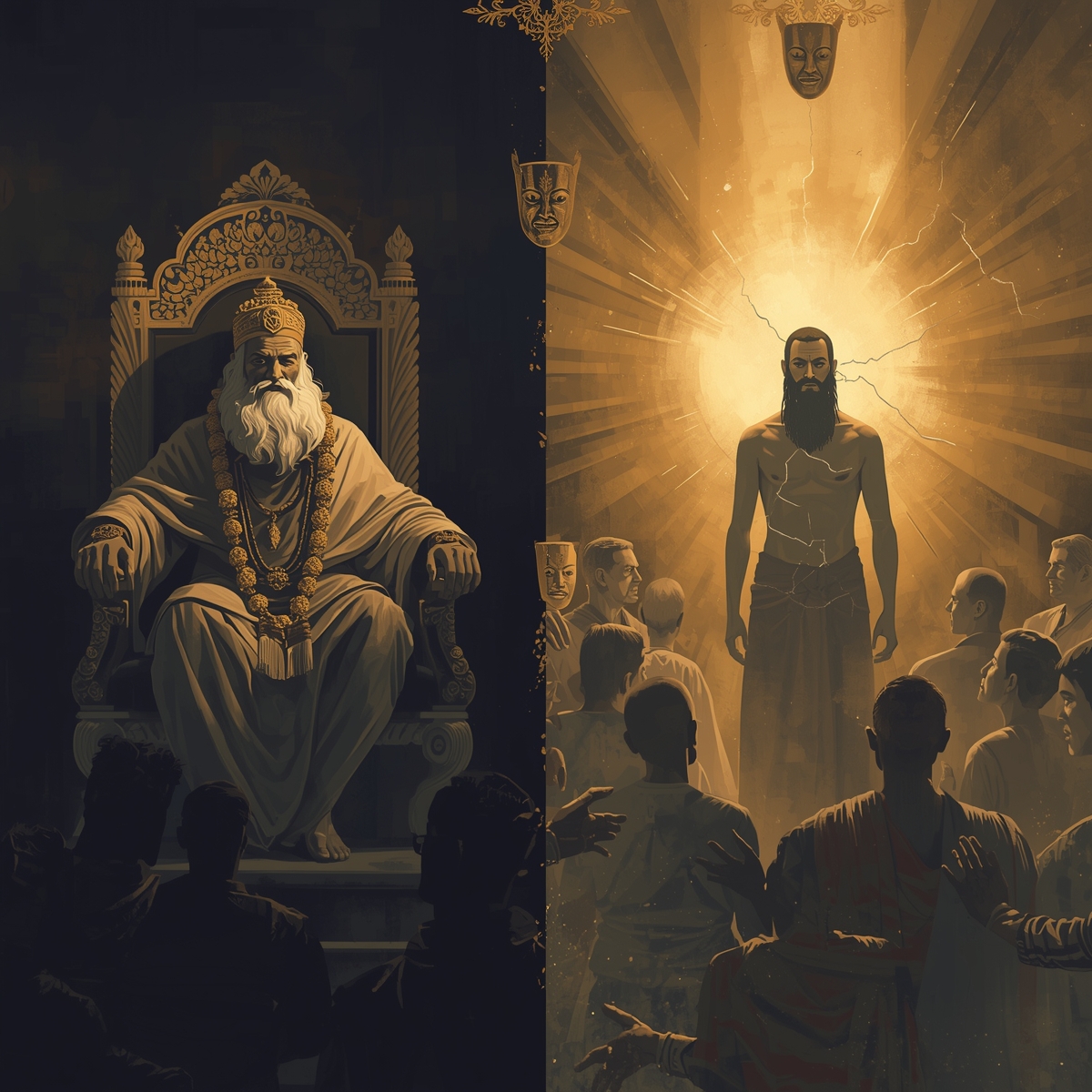


In 1972, A.C. Bhaktivedanta Swami Prabhupada completed his translation of the Bhagavad Gita, opening each of Krishna’s speeches with a phrase of striking intimacy: “The Blessed Lord said.” Twenty-two times throughout the text, this warm invocation appeared—a literary choice that, whether consciously or not, echoed the devotional warmth of the bhakti tradition Prabhupada represented.
By the 1980s, after Prabhupada’s passing, his disciples began revising his translations. “The Blessed Lord said” became “The Supreme Personality of Godhead said.” The change was technically accurate—Bhagavan in Sanskrit does mean the Supreme, Almighty God. But something ineffable had shifted. What was once an invitation to relationship had become a statement of metaphysical hierarchy.
This is not a story about one religious movement or one revised phrase. It is a pattern that repeats across centuries and continents, in traditions as diverse as Christianity, Buddhism, Islam, and the new religious movements of the 20th century. Again and again, the language of founders—charismatic, emotionally direct, resistant to systematization—gives way to the language of institutions: formal, precise, requiring expert interpretation.
The Unconscious Architecture of Institutional Language
Religious scholars have long observed this transition, often framing it through Max Weber’s concept of the “routinization of charisma.” When a charismatic leader dies, Weber argued, their followers face a crisis: How do we preserve the insight without the person? How do we systematize the unsystematizable?
The answer, historically, has been through language revision. Not as conspiracy, but as institutional psychology—a largely unconscious process driven by the sincere belief that one is “improving” or “correcting” the original. Organizations instinctively transform the “language of the founder” into “institutional language” to gain two things modern religious movements desperately seek: academic legitimacy and administrative control.
Consider the early Christian church. The Gospels preserve Jesus’s Aramaic idioms—their earthiness, their parables drawn from agriculture and family life. “The kingdom of heaven is like yeast that a woman took and mixed into about sixty pounds of flour,” he says in Matthew 13:33. This is the language of the kitchen, not the council chamber.
But by the 4th century, Christian theology was being articulated in Greek philosophical categories. The Nicene Creed speaks not of yeast and flour but of “being of one substance with the Father” (homoousios). This wasn’t corruption—it was translation into the language of institutional survival, a vocabulary that could negotiate with Roman emperors and Hellenistic intellectuals.
The transformation is both necessary and costly.
From Peasant Wisdom to Scholastic System
The pattern intensifies in the medieval period. Francis of Assisi (1181-1226) wrote his Canticle of the Sun in Umbrian dialect, addressing Brother Sun and Sister Moon with the unselfconscious intimacy of someone who actually felt kinship with creation. Within a century of his death, the Franciscan order had produced Duns Scotus and William of Ockham—brilliant systematizers whose philosophical precision would have baffled Francis himself.
Thomas Merton observed this tension in his own Catholic tradition. In his journal, he noted how the institutional church had taken the mystical, apophatic tradition—the “dark night of the soul”—and reduced it to stages that could be mapped, tested, and certified. “They have made contemplation,” Merton wrote, “into a science.”
But perhaps the most revealing case study comes from the 19th-century Church of Jesus Christ of Latter-day Saints. Joseph Smith’s early revelations, compiled in the Doctrine and Covenants, overflow with idiosyncratic phrases and divine colloquialisms. God speaks of feeling “sorrowful” (D&C 95:1) and addresses Smith as “my son” with paternal warmth.
Later Mormon theologians, particularly in the 20th century, systematized Smith’s revelations into formal theology—eternal progression, the plurality of gods, temple ordinances as cosmic mechanics. B.H. Roberts and James Talmage wrote treatises that transformed folk revelation into something approaching systematic theology. Again, this wasn’t cynicism. These were devoted believers trying to make Smith’s visions intellectually respectable in an age of scientific rationalism.
The Trade-Off: Precision Versus Presence
Why does this happen? The cynical answer is power—institutions consolidate control by making doctrine require interpretation, and interpretation requires experts. There’s truth in this. When the Bible was translated from Latin to vernacular languages during the Reformation, the Catholic Church resisted precisely because democratizing access to scripture threatened clerical authority.
But the psychological dimension is more subtle. Institutions genuinely believe they are protecting the founder’s legacy by making it more precise. The problem is that precision and presence operate according to different logics.
“The Blessed Lord said” is imprecise. Which aspect of the divine is speaking? Is this Krishna the cowherd or Krishna the cosmic destroyer? The phrase doesn’t clarify—it evokes. It invites emotional participation before intellectual categorization.
“The Supreme Personality of Godhead said” removes ambiguity. We know exactly who is speaking: the ontologically ultimate reality, creator and sustainer of all existence. This is useful for theological debates. It establishes metaphysical hierarchy. But it also distances the reader from the intimacy that drew people to Prabhupada’s translation in the first place.
The Quaker tradition understood this tension. Early Quakers spoke of the “Inner Light” with deliberate vagueness—was it God? Christ? The Holy Spirit? Conscience? They resisted definition because definition would divide. Later Quaker theologians, seeking dialogue with mainstream Christianity, tried to systematize the Inner Light into orthodox Trinitarian categories. The result was intellectually coherent but spiritually thinner.
The Language of Mediation
There’s another dimension to this shift: bureaucratic language creates the need for bureaucracy. When sacred texts speak in the founder’s accessible idiom, anyone can approach them. When they speak in technical terminology, you need experts to mediate.
This is not accidental. Émile Durkheim argued that all religions create sacred/profane boundaries, and professional priesthoods exist to manage those boundaries. The more complex the language, the more essential the mediator becomes.
Consider Zen Buddhism’s koans—paradoxical statements like “What is the sound of one hand clapping?” These were originally teaching tools used in direct conversation between master and student. But as Zen institutionalized, particularly in medieval Japan, koans became standardized into collections (The Gateless Gate, The Blue Cliff Record) with orthodox interpretations.
D.T. Suzuki, the scholar who introduced Zen to the West, lamented this development. The koan, he wrote, “has ceased to be the utterance of a particular person under particular circumstances” and become “a problem to be solved by the intellect.” The institutional language of correctness had overtaken the charismatic language of awakening.
The Hare Krishna Revision
Which returns us to Prabhupada and his disciples. The Bhagavad Gita As It Is (1972) was never meant to be a scholarly translation. Prabhupada was a missionary, not an Indologist. His English was unconventional, his theological explanations often devotional rather than systematic. And this is precisely why the book found an audience.
“The Blessed Lord said” worked because it sounded like someone was actually saying something to you. The phrase carried warmth, personality, accessibility—qualities that drew thousands of young Westerners in the 1970s to Krishna consciousness.
The revision to “The Supreme Personality of Godhead said” is more accurate to ISKCON’s formal theology, which emphasizes Krishna’s absolute supremacy over all other manifestations of divinity. But accuracy and accessibility are not the same thing. The new phrase sounds less like spiritual invitation and more like doctrinal instruction.
One former ISKCON member, interviewed for this essay, put it bluntly: “Reading the revised version felt like the difference between receiving a letter from a friend and reading a legal document about the friend.”
This matters because religious movements succeed or fail based on their ability to generate emotional commitment, not intellectual assent. Prabhupada understood this intuitively. His disciples, seeking to establish ISKCON as a legitimate Hindu denomination rather than a fringe cult, chose intellectual rigor over emotional resonance.
They were trying to protect his legacy. They may have diminished it instead.
Can the Pattern Be Resisted?
Is this pattern inevitable? Some religious movements have tried to resist it. The Unitarian Universalist church explicitly rejected creedal language, creating instead a loose covenant of principles. But even here, the principles have become increasingly elaborated over time—what began as broad affirmations have spawned committee reports and position papers.
The Baha’i Faith made institutional authority explicit from the beginning, establishing a succession of interpretive bodies (the Guardian, the Universal House of Justice) to prevent doctrinal drift. But this solved the problem of competing interpretations by consolidating power—hardly a solution that preserves charismatic immediacy.
Perhaps the tension is inescapable. Charisma cannot be institutionalized without being transformed. The language that captures a founder’s unique voice cannot be preserved in amber—it must either die or evolve, and evolution means adaptation to new environments, new audiences, new purposes.
But there’s a difference between inevitable transformation and unnecessary impoverishment. When Prabhupada’s “Blessed Lord” became “Supreme Personality of Godhead,” something genuine was lost—not theological accuracy, but theological warmth. The revision replaced a term that invited relationship with a term that insists on hierarchy.
The Weight of Words
Language does more than describe reality; it creates it. “The Blessed Lord” conjures a different psychological space than “The Supreme Personality of Godhead.” The first suggests grace; the second, power. The first implies intimacy; the second, distance. These are not neutral substitutions.
The Buddha reportedly said his teachings were like a finger pointing at the moon—one shouldn’t mistake the finger for the destination. Every religious tradition claims to understand this principle. Yet every tradition eventually confuses the precision of its pointing with the luminosity of what’s pointed toward.
The tragedy is not that religious language evolves. It must. The tragedy is that the evolution so often moves in one direction: from warmth to coldness, from invitation to gatekeeping, from “blessed” to “supreme.”
And the people making these changes are not villains. They are sincere believers, often more devoted than those who came before. They genuinely think they are improving the text, making it more accurate, more defensible, more worthy of their teacher’s memory.
But accuracy is not the only value. Sometimes “blessed” is truer than “supreme”—not because it’s more precise, but because it’s more faithful to what drew people to the path in the first place.
This is the paradox at the heart of all institutionalized religion: the tools required to preserve a teaching may be the very tools that transform it beyond recognition. The disciples trying hardest to protect their teacher’s legacy may be the ones most likely to betray it—not through malice, but through the sincere conviction that they know better than he did what he really meant to say.