
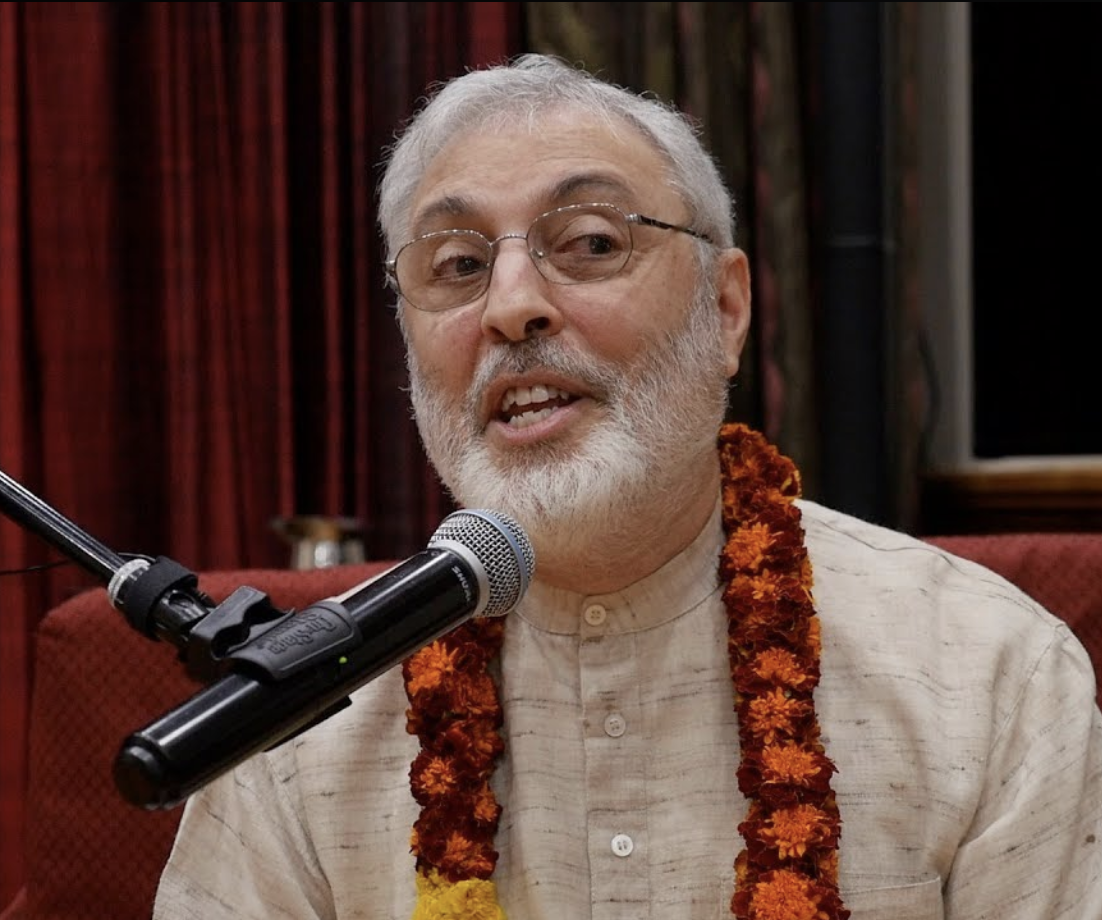
This article is a detailed critique of a proposal made by Garuda dasa (a scholar disciple of Srila Prabhupada) to edit the Bhagavad-gita, a sacred Hindu scripture.
The proposal involves altering the original text of the spiritual work of Bhagavad-gita by adding alternative readings and swapping commentaries between editions for clarity and academic support. The author argues against this, emphasizing the importance of preserving original texts unchanged to maintain their spiritual integrity, authoritative consistency, and devotional value. He suggests keeping each edition intact and publishing any scholarly analysis separately.
Source Video
Table of Contents
- Source Video
- Garuda’s Proposal Summarized
- Refutation #1: Violates Scholarly Method
- Refutation #2: Violates Arsa Prayoga
- Refutation #3: False Conjunction of Principles
- Refutation #4: Transparency Doesn’t Solve the Problem
- Refutation #5: “Swapping Purports” Problem
- Refutation #6: “No Need of Second Edition” Fallacy
- Refutation #7: Practical Problems
- Refutation #8: Reveals Problematic Motivations
- The Correct Alternatives
- Summary of All Arguments
- Definitive Conclusion
- Final Statement
I. Garuda’s Proposal Summarized
Claims:
- Keep original text in body, add alternative readings in end notes
- Sometimes swap purports from 1968 edition if “better”
- Everything clearly marked/transparent
- Balances Arsa Prayoga with Yukta Vairagya in “healthy tension”
- Not a “second edition” - just fixing a bad current edition
- Will gain academic endorsements
II. Refutation #1: Violates Scholarly Method
Primary Source Integrity:
- Scholarly method: Preserve primary sources unchanged
- Garuda’s method: Intervenes in primary source itself
- Counter: “I’m just adding notes” → Adding evaluative commentary undermines the source
Textual Authority:
- Scholarly method: Each edition preserved as historical document
- Garuda’s method: Creates hybrid mixing multiple editions
- Counter: “It’s transparent” → Transparency doesn’t justify intervention
Proper Procedure Examples:
- Biblical scholarship: Original languages preserved; translations separate; commentaries separate
- Shakespeare: First Folio preserved; modern editions clearly labeled by editor
- Dead Sea Scrolls: Fragments untouched; translations separate; interpretations in journals
- Plato: Greek original preserved; multiple translations each attributed to translator
Garuda’s Violation:
- Judges which passages need correction (makes HIM authority)
- Selects alternatives from different editions (creates non-existent text)
- Inserts interpretations within the text (contaminates source)
- Doesn’t publish under own name clearly (avoids responsibility)
- Prevents future access to unmodified originals (destroys historical record)
III. REFUTATION #2: VIOLATES ARSA PRAYOGA
Arsa Prayoga Principle:
“Receive and transmit spiritual knowledge exactly as received, without subjective interpretation”
Garuda’s Violations:
- Assumes authority to determine “what author really meant”
- Introduces subjective judgment: “this might not be what was intended”
- Serves academic approval over faithful transmission
- Makes himself necessary mediator between author and reader
- Changes role from postman (delivers unchanged) to editor (evaluates and modifies)
Analogy:
- Postman opens letters, reads them, adds notes: “This might not be what sender meant”
- Disciple receives teaching, adds footnotes: “Guru might have meant something else” → Both violate the principle of faithful transmission
IV. REFUTATION #3: FALSE CONJUNCTION OF PRINCIPLES
Garuda’s Claim:
“Arsa Prayoga in healthy tension with Yukta Vairagya justifies this approach”
Why This Fails:
No Tension Exists:
- Arsa Prayoga governs: THE MESSAGE (preserve content exactly)
- Yukta Vairagya governs: THE MEANS (use all practical tools for transmission)
- They complement, don’t conflict
Proper Application:
- Arsa Prayoga: Keep the translation unchanged
- Yukta Vairagya: Use modern printing, digital formats, marketing, social media → Result: Unchanged message widely distributed
Garuda’s Misapplication:
- Claims Yukta Vairagya justifies altering the message for academic acceptance
- But Yukta Vairagya = using material means for spiritual purpose
- NOT adjusting spiritual message for material approval
Examples Showing Garuda’s Error:
-
Yukta Vairagya ✓: Use computers to publish books
-
NOT Yukta Vairagya ✗: Change book content to please computer users
-
Yukta Vairagya ✓: Use modern language in NEW translation
-
NOT Yukta Vairagya ✗: Alter existing translation
No Precedent:
- Did Prabhupada use this “tension” to edit Bhaktisiddhanta’s works? NO
- Did any acharya in sampradaya? NO
- Garuda invented this framework to justify desired changes
V. REFUTATION #4: TRANSPARENCY DOESN’T SOLVE THE PROBLEM
Garuda’s Defense:
“Original text remains visible; changes are transparent; therefore acceptable”
Why Transparency Fails:
Problem 1: Psychological Authority Shift
- Text: “The soul is eternal*”
- Note: “*May not be author’s intent; 1968 has ‘imperishable’” → Reader’s confidence undermined; editor elevated above author
Problem 2: Textual Ambiguity
- Which is authoritative: body text or end note?
- If end note is more accurate, why isn’t it in the main text?
- If main text is correct, why suggest alternatives? → Creates confusion, not clarity
Problem 3: Intervention Remains Intervention
Even if transparent, editor still:
- Judges which passages need notes
- Interprets “what author might have meant”
- Makes himself necessary mediator
- Inserts his scholarship into primary text
Problem 4: Changes Nature of Text
- Before: Authoritative teaching for spiritual practice
- After: Object of scholarly debate with textual uncertainty → Undermines devotional use while failing scholarly standards
Analogy: The Defaced Painting
- Curator paints wider smile on Mona Lisa
- Puts plaque: “Original smile shown in photograph”
- Claims: “I’m transparent, so it’s acceptable” → Transparency doesn’t undo the defacement
Biblical Comparison:
- Critical editions: Clearly labeled for scholars; separate from devotional editions
- Garuda: Wants to replace devotional edition with hybrid critical/devotional text → Serves neither audience properly
Real Transparency Would Mean:
- Separate editions clearly labeled
- “Bhagavad-gita (1968 Edition) - Preserved”
- “Bhagavad-gita (Current Edition) - Preserved”
- “Bhagavad-gita: Critical Edition by Garuda Prabhu” → Garuda refuses this because he wants original’s authority for his work
VI. REFUTATION #5: “SWAPPING PURPORTS” PROBLEM
Garuda’s Clarification:
“If I swap a purport from 1968 edition, it will be clearly noted”
Why This Is Worse:
Creates Frankenstein Text:
- NOT the 1968 edition (has some later purports)
- NOT the current edition (has some 1968 purports)
- Garuda’s hybrid that never existed in any authorized form
Who Decides “Better”?
- Garuda’s judgment = final authority
- Based on his scholarship, his preferences
- Makes him supreme editor with veto power over all previous editions
Proper Approach:
- Publish 1968 edition complete and intact
- Publish current edition complete and intact
- Publish Garuda’s critical commentary separately → Readers can access each, compare, and choose
Shakespeare Analogy:
- Editor creates Hamlet using Act 1 from First Folio, Act 2 from Second Quarto, etc.
- Based on which he thinks is “better” for each section
- Notes which source for each part → No Shakespeare scholar would accept this; destroys integrity of each historical edition
What Purport Swapping Means:
- Garuda decides which explanation is “correct”
- Which application is “better”
- Which teaching emphasis is “more accurate” → Makes him final authority on author’s intent
Author’s Revisions:
- When author publishes multiple editions, each represents his teaching at that time
- Author has right to revise his own work
- Editor presuming to “undo” revisions overrules author’s later judgment → Claims to know author’s “real” intent better than author
VII. REFUTATION #6: “NO NEED OF SECOND EDITION” FALLACY
Garuda’s Claim:
- “No need of second edition”
- Because current edition is already bad
- Making “a good one” will solve the problem
Why This Fails:
Logical Fallacy:
- Problem: “Too many unauthorized changes”
- Solution: “More changes by me” → You can’t fix corruption with more corruption
Analogies:
- Poisoned well → Add different poison to fix it? NO - Get fresh water
- Tampered contract → Alter it again? NO - Find original and restore it
- Defaced artwork → Touch it up more? NO - Remove additions scientifically
Who Decides “Good”?
- Garuda’s judgment = standard
- Not: What Prabhupada authorized
- Not: What scholarly consensus determines
- Not: What community wants → “Good” means “Garuda-approved”
Why “No Need of Second Edition” Is Revealing:
He doesn’t want it called “second edition” because:
-
Second editions have less authority than originals
-
Second editions are attributed to their editors
-
Second editions invite comparison and scrutiny
-
Second editions give readers choice
-
Second editions acknowledge they’re different
By refusing the label, Garuda wants:
-
Authority of the original
-
Without responsibility of an editor
-
Appearance of preservation
-
While actually making revisions
Contradictory Arguments:
- Initial: “I’ll preserve with helpful end notes”
- Actual: “Current edition is bad, I’ll create a good one” → Can’t simultaneously preserve (leave unchanged) and correct (create new edition)
Historical Parallels:
Every religious revisionist uses this logic:
- Luther: “Latin Bible corrupted; my German version restores it”
- Jehovah’s Witnesses: “Traditional Bibles corrupted; New World Translation fixes them”
- Thomas Jefferson: “Gospels corrupted; I’ll restore ethical core” → All claimed “restoration” not “revision”; all created competing versions
Proper Response If Current Edition Is Corrupted:
- PATH A: Research earliest authorized edition; republish exactly; document authenticity
- PATH B: Publish critical analysis under your name proving corruption
- PATH C: Create new edition clearly labeled as yours and compete on merits → Garuda chooses none of these; wants to revise while denying revision
VIII. REFUTATION #7: PRACTICAL PROBLEMS
Creates Hybrid Serving No Audience:
Devotional Readers:
- ✗ End notes disrupt spiritual reading
- ✗ Textual doubts interfere with faith-based engagement
- ✗ Complexity added where simplicity needed
Scholarly Readers:
- ✗ Cannot cite text definitively (which version?)
- ✗ Cannot treat as pure primary source
- ✗ Editorial choices not rigorously defended
General Readers:
- ✗ Confused about what’s authoritative
- ✗ Overwhelmed by apparatus
- ✗ Unable to simply engage with teaching
Precedent for Chaos:
- If Garuda’s method accepted, future editors can:
- Create their own hybrids
- Swap different purports
- Assert different “original intents”
- Each claiming transparency → Eventually: no stable text; complete fragmentation
Slippery Slope (Historical Reality):
- Generation 1: “Suggestions in end notes”
- Generation 2: “Move better reading to main text”
- Generation 3: “Remove old reading entirely” → Every tradition that accepted this reasoning ended unrecognizable from original
Citation Problems:
- Scholar cites verse 2.13
- Which version? Body text? End note? Garuda’s preference? → Academic chaos
Comparison to Other Traditions:
- Quran: Every diacritical mark preserved; no “improvement”
- Torah: One wrong letter disqualifies entire scroll
- Buddhist Suttas: Multiple versions preserved separately
- Tao Te Ching: Translators create NEW translations under own names → Why should Prabhupada’s work receive less protection?
IX. REFUTATION #8: REVEALS PROBLEMATIC MOTIVATIONS
Garuda’s Stated Goal:
“It could garner a whole new set of endorsements and appreciations from the academic community”
This Reveals:
- Primary motivation: Academic approval
- Not: Faithful transmission
- Not: Spiritual purity
- Not: Community need → Serving personal/academic reputation over tradition
Self-Serving “Balance”:
- “Healthy tension” conveniently resolves in favor of his desired changes
- Every time the “balance” is struck, it favors editing over preservation → The framework is designed to justify predetermined conclusion
Avoids Responsibility:
- Won’t call it “second edition” = won’t take ownership
- Won’t publish as “Garuda’s Critical Edition” = wants original’s authority
- Claims “just helping readers” = denies actual intervention
- Hides behind “transparency” and “balance” = rhetorical shield → Intellectual dishonesty
Questions Garuda Won’t Answer:
- On what authority do you determine “good” version?
- If problem is unauthorized changes, why is solution more changes?
- How is your approach different from every other revisionist who claimed to “restore”?
- Why not publish clearly as “Bhagavad-gita: Critical Edition by Garuda Prabhu”?
- If later editors “fix” your edition, is that acceptable?
- Would you accept this treatment of your own writings?
- Where does this process stop?
X. THE CORRECT ALTERNATIVES
If Garuda Wants to Serve the Tradition:
Option 1: Preserve Multiple Editions
- “Bhagavad-gita As It Is (1968 First Edition) - Unaltered”
- “Bhagavad-gita As It Is (Current Edition) - Unaltered”
- Let readers choose based on their needs → Honors all versions; serves different audiences
Option 2: Publish Critical Apparatus Separately
- Volume 1: Current edition (unchanged)
- Volume 2: “Textual Commentary and Variant Readings by Garuda Prabhu”
- Cross-reference but keep separate → Serves scholars without contaminating devotional text
Option 3: New Translation
- “The Bhagavad-gita: A New Translation by Garuda Prabhu”
- Take full responsibility for all choices
- Explain methodology in introduction
- Compete with other translations on merits → Honest, scholarly, responsible
Option 4: Critical Study
- “Critical Analysis of Editorial History of Bhagavad-gita As It Is”
- Document all changes between editions
- Argue for preferred readings with evidence
- Publish under own name for evaluation → Contributes to knowledge without tampering with source
All These Approaches:
-
✓ Preserve integrity of original(s)
-
✓ Allow scholarly analysis
-
✓ Give Garuda credit for his work
-
✓ Maintain transparency
-
✓ Serve appropriate audiences
-
✓ Set no dangerous precedent
-
✓ Honor both scholarship and Arsa Prayoga
What Garuda Proposes Does NONE Of This.
XI. SUMMARY OF ALL ARGUMENTS
Garuda’s Proposal:
- Keep text in body; add alternatives in end notes
- Swap purports between editions when “better”
- Transparently marked
- Balances Arsa Prayoga with Yukta Vairagya
- Not a “second edition” - just fixing bad current edition
- Will gain academic endorsements
Complete Refutation:
Violates Scholarly Method:
- ✗ Intervenes in primary source (should preserve intact)
- ✗ Creates hybrid text that never existed (should publish each edition separately)
- ✗ Embeds editorial judgment within source (should separate commentary)
- ✗ Prevents access to unmodified originals (should ensure preservation)
Violates Arsa Prayoga:
- ✗ Introduces subjective interpretation (should transmit exactly as received)
- ✗ Makes editor necessary mediator (should deliver directly)
- ✗ Serves academic approval (should serve faithful transmission)
- ✗ Assumes authority to improve guru’s words (should humbly preserve)
False Conjunction:
- ✗ No “tension” between principles (they complement in different domains)
- ✗ Yukta Vairagya doesn’t justify message alteration (only means optimization)
- ✗ No precedent in sampradaya (Garuda invented this framework)
Transparency Fails:
- ✗ Doesn’t undo intervention (still contaminates source)
- ✗ Creates textual ambiguity (body vs. end note authority)
- ✗ Undermines confidence (suggests text might be wrong)
- ✗ Changes nature of text (from authoritative teaching to debated document)
Swapping Purports Worse:
- ✗ Creates Frankenstein text (not any actual edition)
- ✗ Makes Garuda supreme authority (his judgment overrules author)
- ✗ Overrules author’s own revisions (presumes to know intent better)
“No Second Edition” Fallacy:
- ✗ Fixes “corruption” with more corruption (illogical)
- ✗ Reveals desire for authority without responsibility (dishonest)
- ✗ “Good” means “Garuda-approved” (circular reasoning)
Practical Problems:
- ✗ Serves no audience well (neither devotional nor scholarly)
- ✗ Sets precedent for chaos (unlimited future intervention)
- ✗ Makes citation impossible (which version?)
Problematic Motivations:
- ✗ Seeks academic approval (stated goal)
- ✗ Avoids responsibility (won’t call it what it is)
- ✗ Self-serving framework (“balance” always favors his changes)
XII. DEFINITIVE CONCLUSION
What Garuda Should Do:
- Preserve each edition intact
- Publish his scholarship separately under his own name
- Take full responsibility for his work
- Let readers choose between versions
- Honor both scholarly method and Arsa Prayoga
What Garuda Is Actually Doing:
- Creating hybrid based on his judgment
- Embedding it within “original” work
- Denying it’s a new edition
- Claiming authority of original for his revisions
- Using sophisticated rhetoric to mask intervention
The Core Issue:
Not whether changes are transparent But whether intervention should happen at all
Both scholarship and Arsa Prayoga say: NO
- Preserve primary sources
- Publish interpretations separately
- Take responsibility for your work
- Don’t contaminate the transmission
Garuda’s Defense:
Uses philosophical language and scholarly apparatus To do what every revisionist does: Insert his judgment while claiming to preserve original
The Honest Test:
Would Garuda accept future editors doing to his edition What he proposes doing to the current edition?
If NO → Admits his intervention is problematic If YES → Opens door to infinite regression of “improvements”
Either answer defeats his proposal.
XIII. Final Statement
Garuda’s proposal fails every test:
-
Scholarly integrity
-
Arsa Prayoga fidelity
-
Logical consistency
-
Practical utility
-
Honest transparency
-
Respect for tradition
-
Service to readers
No amount of sophisticated rhetoric changes this.
The proper response:
PRESERVE THE TEXTS. PUBLISH YOUR SCHOLARSHIP SEPARATELY. TAKE RESPONSIBILITY FOR YOUR WORK. LEAVE THE TRANSMISSION INTACT.
Everything else is rationalization.